
Female Gamers in 2026: Statistics, Trends and Market Impact
The global gaming audience reached 3.32 billion active players in 2026, and women are a major part of that growth. Female gamers are no longer a marginal segment of the industry – they represent a structurally significant share of players across regions, platforms, and age groups.
Understanding women in gaming statistics today is less about proving participation and more about understanding behavior, spending, and influence.
What Percentage of Gamers Are Female?
Globally, there are approximately 1.39 billion female gamers, compared to about 1.7 billion male gamers, according to 2026 data. That places the percentage of female gamers worldwide at roughly 42-47%, depending on region and methodology (Exploding Topics, 2026).
In the United States, the split is even clearer. ESA’s 2025 Essential Facts report shows that 47% of gamers are women and 52% are men. The gap has narrowed steadily over the past two decades, reflecting long-term structural change rather than a temporary trend.
In practical terms, this means nearly half of the addressable gaming audience is female – a reality that directly affects product development, marketing, and monetization strategy.

Female Gamers Across Generations
Gaming is no longer youth-exclusive. ESA reports that the average gamer is 36 years old, and nearly two-thirds of Americans aged 5–90 play video games.
Women are active across every age group. Notably:
- 52% of boomer women play video games, compared to 46% of boomer men
- 60% of US adults (18+) play weekly
This cross-generational presence matters commercially. Female gamers include teenagers, young professionals, parents, and retirees – each with different motivations and purchasing behaviors. Treating women gamers as a single demographic block oversimplifies the market.
What Games Do Women Play?
Data from the Women Gamers Study 2024 (Bryter) shows that women’s genre participation is broad and competitive. Among surveyed women in the US and UK:
- 56% regularly play action-adventure games
- 49% play shooters
- 47% play battle royale titles
- 40% play life simulation games
- 37% play puzzle games
Women average around 20 hours of gaming per week, indicating sustained engagement rather than casual or occasional participation.
Mobile gaming is also significant. Women spend nearly 8 hours per week on mobile, compared to 6.5 hours for men. At the same time, console remains central, with PlayStation 5 highlighted as a leading platform among engaged players.
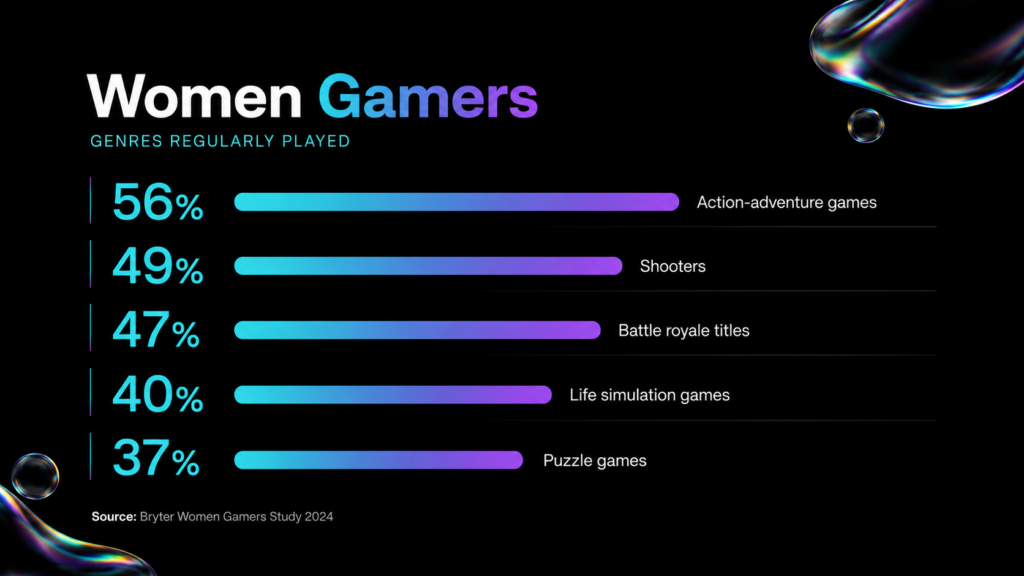
The takeaway is not genre specialization but genre diversity.
Why Women Play
Across all gamers globally, relaxation remains the top motivation for gaming:
- 66% play to unwind
- 51% play for entertainment and escapism
- 48% play to spend time alone
For women specifically, Bryter’s study emphasizes immersion, storytelling, and world-building as strong drivers of engagement. Women are also more likely to use gaming as shared time – playing with partners (44%) or children (28%).
ESA’s 2025 report reinforces this family dynamic. 82% of parents who play video games play with their children, and many cite fun and connection as primary reasons. Women are central to this co-play ecosystem.
Spending Power and Market Influence
The gaming market is projected to reach $564.27 billion in 2026. Female gamers contribute meaningfully to that total.
According to the Women Gamers Study 2024:
- Average annual spend: $304 in the US
- Average annual spend: £277 in the UK
- Women are as likely as men to spend on DLC and expansions
- Women may outspend men on cosmetic items
Spending patterns also show a stronger reliance on recommendations, gameplay footage, and brand familiarity compared to traditional advertising alone. This shifts influence toward creators, peer networks, and community trust.
Community Experience and Retention
While participation is high, experience in online spaces remains uneven. Bryter reports that 59% of women experienced toxicity from male players in 2024, down from 72% in 2022 but still substantial. Sexual harassment and threats remain present in reported data.
These experiences affect behavior. Some women avoid voice chat, limit multiplayer participation, or play primarily with known contacts. From a market perspective, community design and moderation policies directly influence retention and lifetime value.
The Business Implication
Female gamers in 2026 represent:
- Nearly half of global players
- Strong cross-generational participation
- Multi-genre engagement
- Hundreds of dollars in annual spend per player in mature markets
Their influence extends beyond audience size. It shapes monetization models, cosmetic economies, co-play mechanics, and expectations around representation and safety.
Brands and publishers that understand this demographic as foundational – rather than secondary – are better positioned to capture long-term value in a market that continues to expand.