For BrandsMarketing18.06.2026
Live Advertising in 2026: Formats, Examples, and Why Live Stream Ads Earn Different Attention
A pre-roll ad and a live stream integration can reach the same person on the same screen, and the brain files them under two different categories. One is an interruption the viewer waits out. The other is part of an experience the viewer chose to attend and is paying attention to in real time.
That difference is the whole argument for live advertising. The format does not sit between the viewer and the content they came for. It appears inside the content, at a moment the viewer is already engaged. For a marketer used to buying impressions against pre-recorded video, this changes what the spend buys: not exposure to a passive audience, but presence in an active one.
How live advertising differs from pre-recorded video
A pre-recorded ad is content that exists independently of whatever the viewer chose to watch. It is inserted before, during, or after the real content, and the viewer treats it as a toll to pay. Skip it, mute it, or wait it out.
Live advertising works the other way around. The brand element is triggered by or embedded in content the viewer is actively experiencing as it happens. There is no separate clip to skip, because the brand appears as part of the live moment. The viewer cannot pause, rewind, or fast-forward past it, because the stream is happening in real time.
The audience this reaches is unusually committed. 77% of livestream viewers spend more than five hours a week watching, according to inStreamly’s Live Streaming Trends 2025 data, and they tend to participate through chat rather than watch passively. That is a different starting condition than a feed scroller flicking past an autoplay video in under a second.
What are the three formats of live stream advertising?
Live advertising in a streaming context takes three main forms, and all three share one structural property worth understanding before the formats themselves:
- Overlay-based ads are branded graphics that appear over the stream without stopping it. The stream keeps running underneath while the brand element sits on screen.
- Chat-triggered ads are interactive branded elements that fire when specific keywords appear in viewer chat. The audience summons the brand moment through its own behavior.
- Voice and gameplay-triggered ads respond to what the streamer says or what happens inside the game. A spoken phrase or an in-game event sets off a contextual brand appearance tied to that exact moment.
The shared property is the important part: none of these formats makes an external ad call. They are delivered as part of the stream itself, not fetched from a separate ad server, so there is nothing for an ad blocker to intercept. The brand is inside the broadcast, not bolted onto it.
Who watches live streams, and why it matters for advertisers
The live streaming audience is large, growing, and concentrated in exactly the demographic that legacy media buys keep missing.
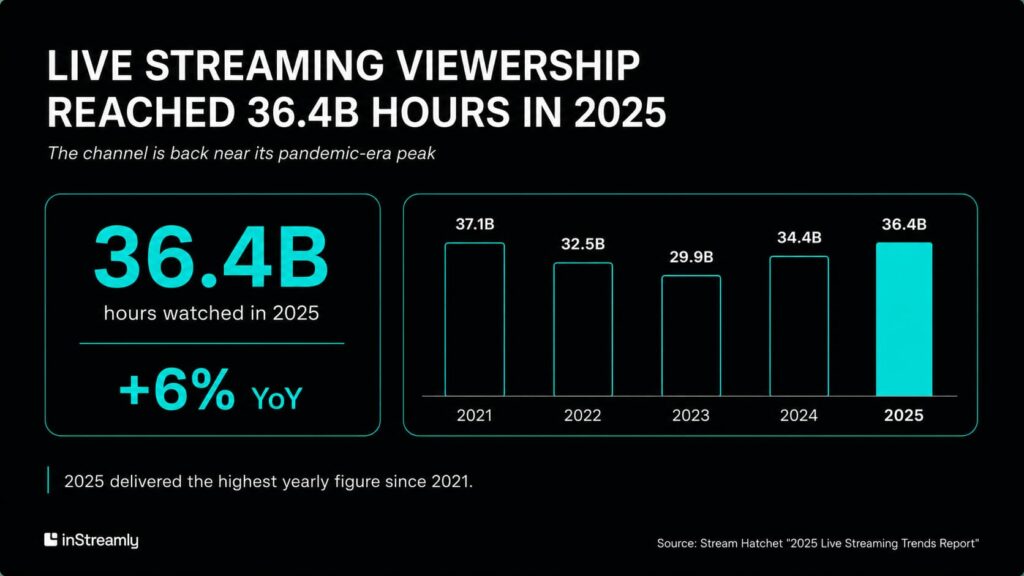
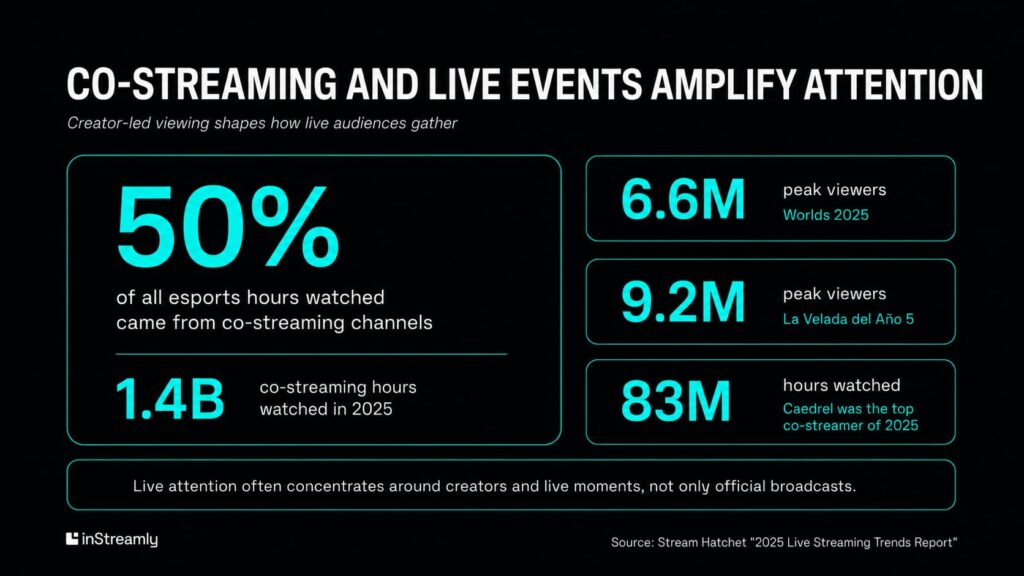
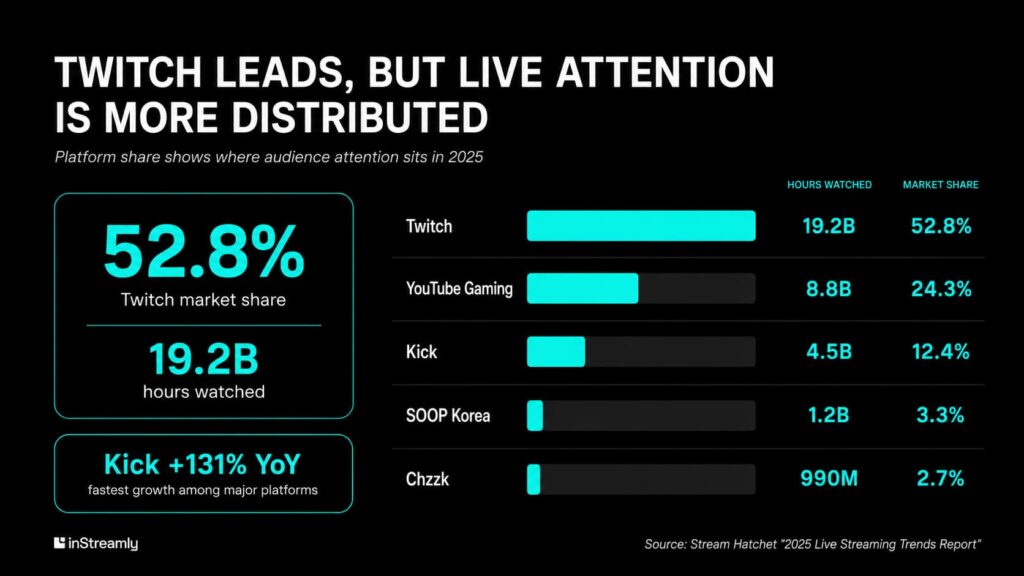
Global live streaming viewership reached 36.4 billion hours watched in 2025, up 6% year over year, according to Stream Hatchet’s annual report, close to the pandemic-era peak. This is not a niche channel waiting to mature.
The audience composition is the part that should move a media planner. 62% of livestream viewers have abandoned traditional TV, per inStreamly’s 2025 data, which means a TV-weighted plan never reaches them. 73% of viewers are aged 16 to 34, with another 17% between 35 and 44, and 35% of stream audiences are now women, a sharp shift from the male-dominated picture of a few years back. For a brand trying to reach younger adults who have left television, this is where they went.
What does live advertising deliver that standard formats don’t?
Two things, and they compound:
- Reach that survives ad blocking. Because contextual overlays make no external ad call, there is nothing for a blocker to catch. This matters because gaming audiences block at high rates. 64% of gamers use ad-blocking tools, per inStreamly’s data, which quietly removes a large share of a standard digital buy before it renders. Live advertising reaches the people standard formats cannot.
- Attention quality. A live viewer is engaged in the moment rather than passively exposed, and the audience reads the brand differently as a result. 79% of Twitch viewers see in-stream brand integrations as support for the creator rather than as advertising. When a brand appears at a point of excitement or community participation, it encodes more deeply than the same message dropped into a passive feed. Active attention is the difference between being remembered and being skipped, which is why the attention economy rewards formats that earn focus instead of buying exposure.
What brands achieved with live advertising
The results are concrete, and they come from non-endemic brands rather than gaming companies:
- Dr. Oetker ran a live campaign for its Guseppe pizza brand using 1,896 personalized creatives, one per streamer, lifting ad recall by 33 percentage points and purchase intent by 11. That personalization was only possible because the brand element was generated and delivered live, per creator, not shipped as one fixed spot.
- Danone took a different route. Its Small Hunger character appeared through AI gameplay analysis at the moment a player’s in-game energy dropped, reaching 650,000 views with a viewer reaction described as fascination rather than irritation. The brand showed up because the game created the cue, not because a timer ran out.
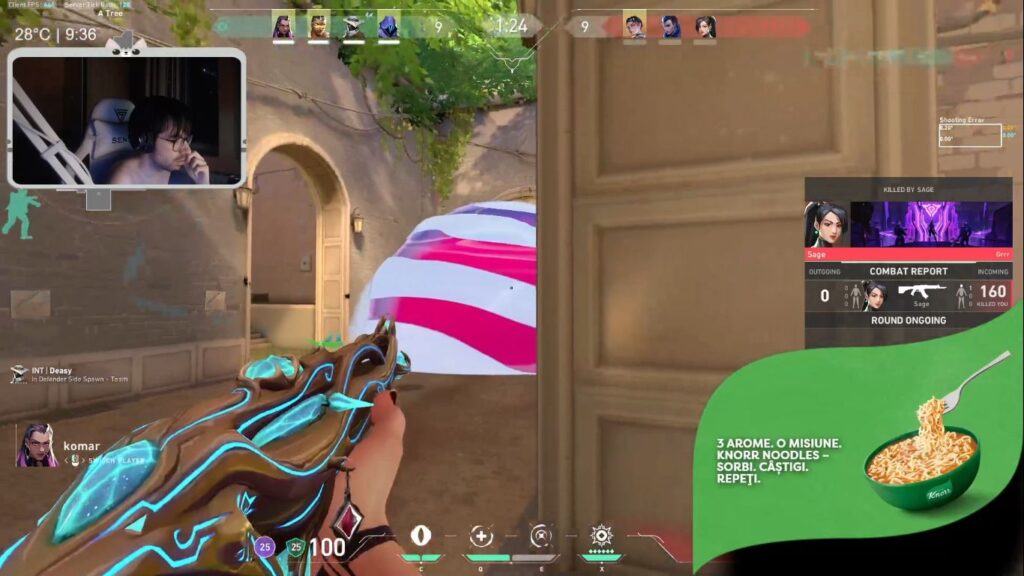
- Knorr ran contextual voice-triggered appearances in a Romanian campaign and recorded a 52 percentage point lift in ad recall, among the highest figures recorded for a non-endemic brand. Standard digital recall lift typically sits in single digits, which puts that result in a different range.
Where does live advertising fit in a media plan?
Live advertising is not a replacement for reach-based buys. It serves a different objective and uses a different measurement model, so it belongs alongside programmatic rather than instead of it.
The strongest fit is a brand awareness objective aimed at the audience that has left television, a brand lift goal where recall and affinity are the KPIs, or a need for non-blockable reach into gaming audiences. If the goal is raw impression volume at the lowest CPM, programmatic still does that job.
Measurement should match the format. Run brand lift surveys before and after the campaign, track verified clicks to filter bots, and monitor organic mentions when the campaign is built to be repeated by the audience. The entry point is flexible: a live campaign can run across ten creators or ten thousand, so it scales to the budget rather than demanding a fixed minimum.
The takeaways
- Live advertising appears inside content the viewer chose and is watching in real time, so it cannot be skipped, paused, or blocked the way pre-recorded formats can.
- It reaches an audience standard buys miss: 62% of livestream viewers have left traditional TV, gaming audiences block ads at 64%, and live viewership hit 36.4 billion hours in 2025.
- The proof is in non-endemic results. Dr. Oetker, Danone, and Knorr posted double-digit and higher brand lift because the brand appeared at an engaged moment rather than as an interruption. Use it for recall and affinity objectives, not as a swap for reach-based programmatic.