Types of Gamers: Casual and Hardcore Gamers as Target Groups

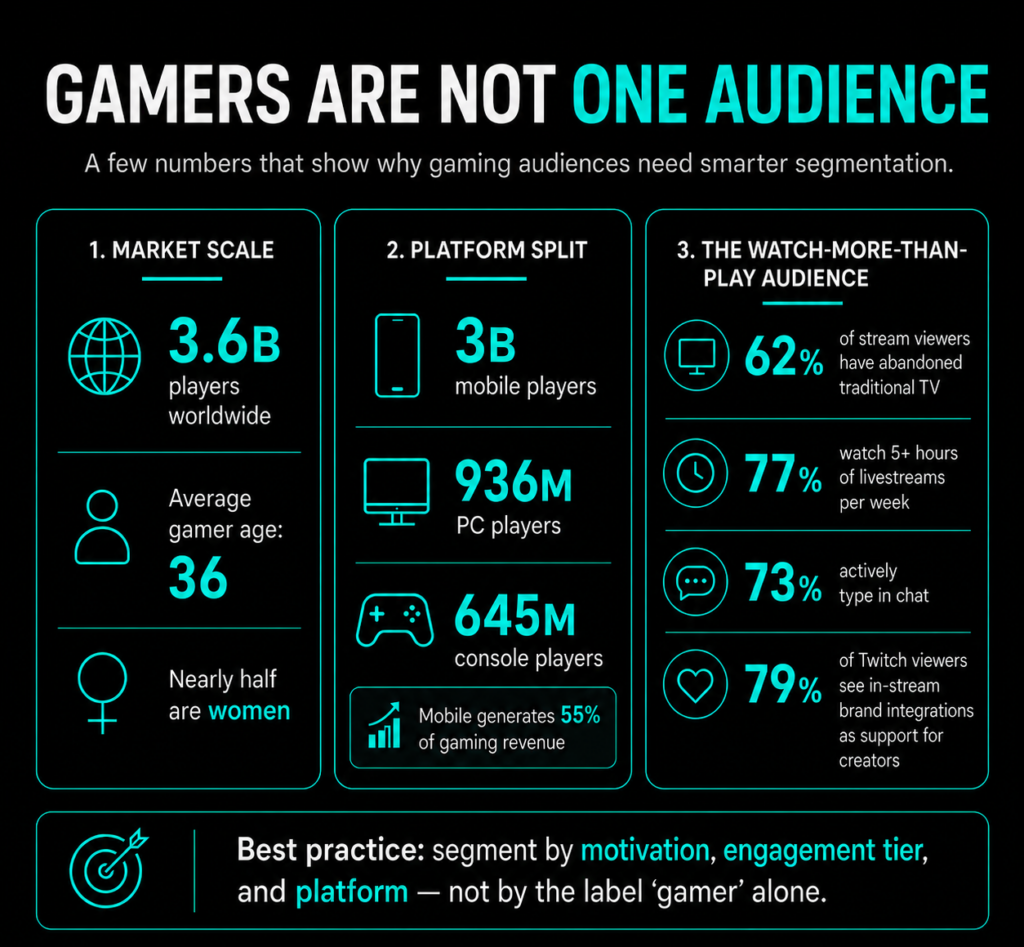
The gamer who blocks every ad on YouTube, skips pre-roll on streaming apps, and pays for an ad-free music tier is often the same person who watched a streamer talk about an energy drink for four minutes without flinching. That contradiction is the core problem with planning a gaming campaign. There is no single “gamer” to target. There are roughly 3.6 billion people who play video games worldwide, the average one is around 36 years old, and close to half are women.
When a brief says “we want to reach gamers,” it describes an audience larger than the population of any single country and more varied than almost anything else a media planner handles. The useful question is not whether to advertise to gamers. It is which types of gamers you are actually trying to reach, and what each group responds to. This guide breaks down the segmentation models that matter for media planning, updates the numbers behind them, and shows where each model helps you and where it quietly misleads you.
Why casual vs hardcore stopped being enough
For years the default split was two boxes: casual gamers who played a bit of Candy Crush on the bus, and hardcore gamers who lived inside competitive shooters. That binary was already strained a decade ago. In 2026 it breaks completely.
The reason is scale and spread. The market reached $188.8 billion in revenue in 2025 and is projected near $205 billion in 2026, which puts gaming ahead of the global film and recorded music industries combined. An audience that size does not sort neatly into two personalities.
The casual vs hardcore axis still tells you something real about how much time and money someone spends. What it does not tell you is why they play, where they play, or whether they spend more hours watching games than playing them. A 38 year old woman who plays a mobile match-three game for 30 minutes a night and a 19 year old who watches six hours of Twitch a day are both invisible to the old binary, yet they need completely different creative and completely different channels. To plan well, you need more than one axis.
Types of gamers by motivation: the Bartle model
The most durable way to segment players is by what they are chasing inside a game. Richard Bartle’s 1996 framework still anchors most modern thinking, and it splits players into four motivations.
Achievers play to win, rank up, and complete things. Status and progress drive them. Explorers play to discover systems, maps, lore, and hidden mechanics. Socializers play mostly for the people, with the game as a backdrop for hanging out. Killers play to compete against and dominate other players directly.
Why does this matter to a marketer who does not build games? Because motivation predicts message fit better than age or platform does. A reward mechanic or a leaderboard activation lands with Achievers and falls flat with Socializers. A community-led campaign built around shared moments reaches Socializers and bores Killers. When a brand integration matches the motivation a player brought to the session, it reads as part of the experience. When it ignores that motivation, it reads as noise.
Most people are not one pure type. They lean toward a primary motivation with a secondary one close behind. For planning, the takeaway is simple. Decide which motivation your brand or product naturally speaks to before you decide which game or streamer to appear in.
How do gamers split by platform?
Platform is the segmentation axis most planners reach for first, because it maps directly to where the media runs. The three groups have very different sizes and very different cultures.
Mobile is the largest by far. Around 3 billion people play on phones, and mobile now generates roughly 55% of all gaming revenue. This is the broadest, most demographically mixed group, skewing toward shorter sessions and free-to-play titles. PC sits at about 936 million players and is home to much of the streaming and competitive culture. Console covers around 645 million players and tends toward longer, more committed sessions on a smaller library of premium titles.
Platform tells you reach and context, not personality. A mobile gamer might be a hardcore strategy player or a five-minute time filler. What platform does give you is a planning constraint. If your goal is broad reach across a mixed audience, mobile is the volume play. If your goal is depth, community, and the streaming layer that sits on top of gaming, PC and console are where that activity concentrates. A useful next step here is a closer look at who today’s gamers actually are by age, gender, and device, because the platform averages hide a lot of variation.
Casual, core, and hardcore gamers still matter for budgeting
The old binary is incomplete, but the engagement tier behind it is still the cleanest way to think about value per impression. Split the audience into three tiers by how much they play and spend.
Casual gamers are the volume. Casual titles attract about 63% of all global gamers, roughly 1.95 billion players. Most spend little or nothing directly, so their value to a brand is reach and frequency rather than deep engagement. Core gamers play regularly, follow releases, and spend on titles and hardware. Hardcore gamers are the smallest tier by headcount, but they anchor communities, attend events, and shape what everyone else plays and watches.

For budgeting, the mistake is treating these tiers as a funnel where hardcore is the only prize. Casual players carry the reach numbers that make a campaign efficient. Hardcore players carry the cultural weight that makes a campaign credible. A plan that ignores the casual tier overpays for reach. A plan that ignores the hardcore tier buys impressions with no community to validate them. Most strong gaming campaigns touch more than one tier on purpose.
What about gamers who watch more than they play?
There is a type of gamer the older models miss entirely, and it is the one that matters most for advertising. A large share of the gaming audience now spends more time watching other people play than playing themselves.
This group lives on live streams, and it behaves unlike any standard digital audience. It is also an audience that filters out conventional advertising. Over 900 million people use ad blockers globally, and in gaming environments usage runs above 60%. The same report finds that 79% of Twitch viewers see in-stream brand integrations as a way to support the creators they watch rather than as advertising. The distinction is the whole opportunity. When a brand appears as part of the stream, tied to what the creator is doing in the moment, it is not filtered out the way a display banner is. This is the type of gamer that brands struggle to reach anywhere else and the reason contextual streaming advertising exists.
How to turn gamer types into a media plan
Knowing the types is only useful if it changes what you buy. Here is a practical sequence for moving from segmentation to a brief.
First, define the motivation your brand fits. Are you a reward for Achievers, a shared moment for Socializers, a discovery for Explorers? This decides your creative angle before anything else.
Second, choose the engagement tier that matches your goal. Reach campaign or awareness push leans casual and broad. Credibility or community play leans core and hardcore.
Third, pick the platform and channel that carries that combination. Broad mobile reach, or the streaming layer on PC and console where the watch-more-than-play audience sits.
Fourth, match the format to context, not just placement. This is where contextual streaming has a measurable edge, because it ties the brand to a live moment instead of interrupting one. T-Mobile’s “The Fastest Network” campaign turned a brand phrase into more than 10,000 organic streamer mentions and a 16 point lift in brand affinity by triggering on natural speech rather than buying interruptions. Danone’s Small Hunger character appeared the moment a player’s in-game energy dropped, with 100% trigger precision, and viewers reacted with curiosity rather than irritation. Knorr’s contextual campaign in Romania recorded a 52 point lift in ad recall, among the highest results recorded for a non-endemic brand. The common thread is relevance to the moment, which is exactly what the watch-more-than-play audience rewards.
If streaming is new territory for your team, a structured starting point is this guide to running ads on Twitch, which covers the formats available and how contextual placements differ from standard ones.
Key takeaways
- There is no single gamer. Segment by at least two axes: motivation (why they play) and engagement tier (how much they play and spend). Platform tells you reach and context, not personality.
- The audience that watches more than it plays is the one standard advertising misses most. It rejects interruptive formats and rewards brand appearances tied to a live moment.
- Move from segmentation to a brief in order: define the motivation you fit, choose the engagement tier that matches your goal, pick the platform that carries it, then match the format to context rather than just placement.
Start Your Own Marketing Campaign With Gamers!
Do you want to make your brand popular among Gen Z and run marketing campaigns with high ROI? Contact us now!