
Gamer Demographics in 2026: Who Are Today’s Gamers?
For years, the stereotype of a gamer was simple: teenage boy, console, bedroom. The data in 2026 tells a completely different story.
Gaming is now one of the largest entertainment activities in the world, spanning generations, genders, devices, and regions. To understand modern audiences – whether for marketing, media, or product strategy – we need to look at real gamer statistics rather than outdated assumptions.
How Many Gamers Are There in the World?
The global gaming population has reached approximately 3.32 billion players in 2024, up from 3.22 billion in 2023, and is projected to reach around 3.5 billion in 2025.
That means over 40% of the world’s population plays video games in some form (G2A, 2026).
This scale alone challenges the idea that gaming is a niche hobby. It is mainstream global entertainment.
Gamer Demographics: Age Breakdown
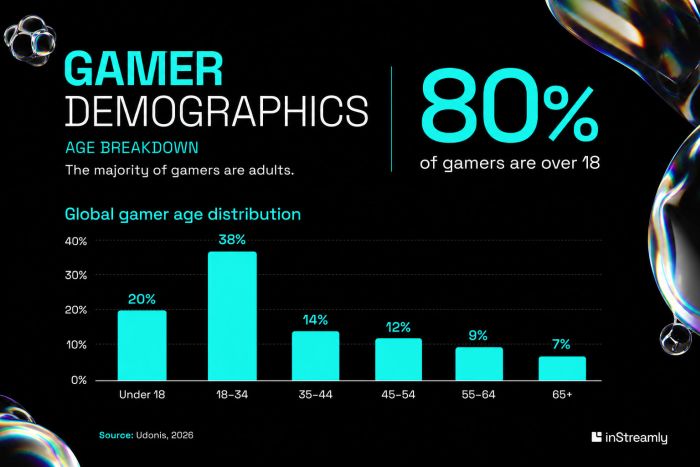
One of the most persistent myths about gaming is that it is dominated by teenagers.
In reality, the majority of gamers are adults.
- Approximately 80% of gamers are over 18
- The largest segment globally is 18–34-year-olds (about 38%)
- Around:
- 14% are aged 35–44
- 12% are aged 45–54
- 9% are aged 55–64
- 7% are 65+
This means hundreds of millions of gamers are over 45, and more than 200 million are seniors.
What Is the Average Age of Gamers?
While reports focus on age distribution rather than a single number, the dominance of the 18–34 group – combined with strong representation among 35+ players – shows that today’s gaming audience skews adult, not adolescent.
Gaming is now a cross-generational activity.
Gamer Gender Distribution
Another outdated stereotype is that gamers are overwhelmingly male.
Global gaming demographics show a near-balanced gender split:
- 45% of gamers are women
- 55% are men (G2A, 2026)
In raw numbers, that translates to roughly 1.4+ billion female gamers worldwide.
Mobile gaming, in particular, has played a major role in broadening gender representation, attracting audiences that traditional console marketing historically overlooked.
The idea that gaming is “for boys” no longer reflects reality.
Regional Gaming Statistics
Gaming is global, but distribution varies by region.
According to both Udonis (2026) and G2A (2026):
- Asia-Pacific: ~1.48 billion gamers
- Europe: ~715 million
- Latin America: ~420 million
- North America: ~285 million
- MENA: ~168 million
- Sub-Saharan Africa: ~144 million
- Oceania: ~32 million
Asia alone accounts for nearly half of the world’s gaming population.
Emerging markets – particularly in Southeast Asia, Latin America, and parts of Africa – continue to drive global growth, largely through mobile adoption.
Where Do Gamers Play? Device Demographics
Mobile gaming has fundamentally reshaped gamer demographics.
There are approximately 2.85 billion mobile gamers globally, making mobile the largest gaming platform by reach (Udonis, 2026).
By comparison:
- ~908 million play on PC
- ~630 million play on consoles (Udonis, 2026)
Many gamers use multiple platforms, but mobile has dramatically expanded who qualifies as a gamer. A person playing puzzle games on a smartphone during a commute is just as much part of the gaming population as someone playing AAA titles on a console.
This shift explains much of the demographic diversification seen today.
Casual vs. Hardcore: Time Spent Gaming
Gaming behavior varies widely.
A 2021 CTA study cited by G2A (2026) breaks down U.S. players into:
- 41% casual players (≈13 hours/week)
- 34% core players (≈29 hours/week)
- 25% hardcore players (≈37 hours/week)
The majority of gamers are not playing 40 hours per week. Most are casual participants engaging with games as flexible entertainment.
This matters for advertisers and brands: the “average gamer” is far more likely to resemble a mainstream media consumer than an esports competitor.
Who Are Gamers in 2026?
If we combine global gaming statistics, a clearer picture emerges:
Today’s gamers are:
- Mostly adults
- Nearly gender balanced
- Heavily mobile-first
- Globally distributed
- Behaviorally diverse
They include:
- Parents playing puzzle games
- Professionals gaming after work
- Teens competing in online shooters
- Seniors engaging with casual mobile titles
Gaming is no longer a subculture. It is a mass audience.
Why Outdated Stereotypes Persist
The stereotype of young male gamers comes from an earlier era of console-dominated markets and highly visible hardcore communities.
What changed:
- Smartphones expanded access
- Free-to-play lowered barriers
- Social gaming normalized participation
- Cross-platform titles blurred categories
As gaming became more accessible, the demographic base expanded accordingly.
The data reflects that evolution.
What Gamer Demographics Mean for Brands and Media
Understanding gamer demographics is critical for:
- Media planning
- Influencer partnerships
- In-game advertising
- Audience targeting
- Product positioning
Treating “gamers” as a single niche audience leads to misaligned campaigns. A mobile casual gamer in her 40s has different motivations and media habits than a competitive PC player in his 20s. Both are gamers – but they are not the same audience.
Effective strategy starts with segmentation, not stereotypes.