
Gaming Industry Trends: Where the Market Is Heading in 2026
The gaming industry enters 2026 with renewed momentum. After a period of post-pandemic correction, gaming market growth is accelerating again — but the structure of the market is fundamentally different than it was even three years ago.
Platform convergence, generative AI, cloud gaming, user-generated content (UGC), and distribution shifts are redefining how value is created and captured. For brands and marketers, understanding gaming industry trends now requires going beyond surface-level gaming industry statistics. It demands structural thinking.
Below, we break down where the video game market growth is coming from — and what it means for brands targeting gaming audiences.
Gaming Market Growth in 2025–2026: Scale and Structure
The global video game market reached $260 billion in 2025, supported by 3.49 billion active players worldwide. Revenue is projected to reach $268 billion in 2026 and grow to $320 billion by 2030, representing a 10.2% compound annual growth rate (Video Game Statistics 2026, Icon Era).
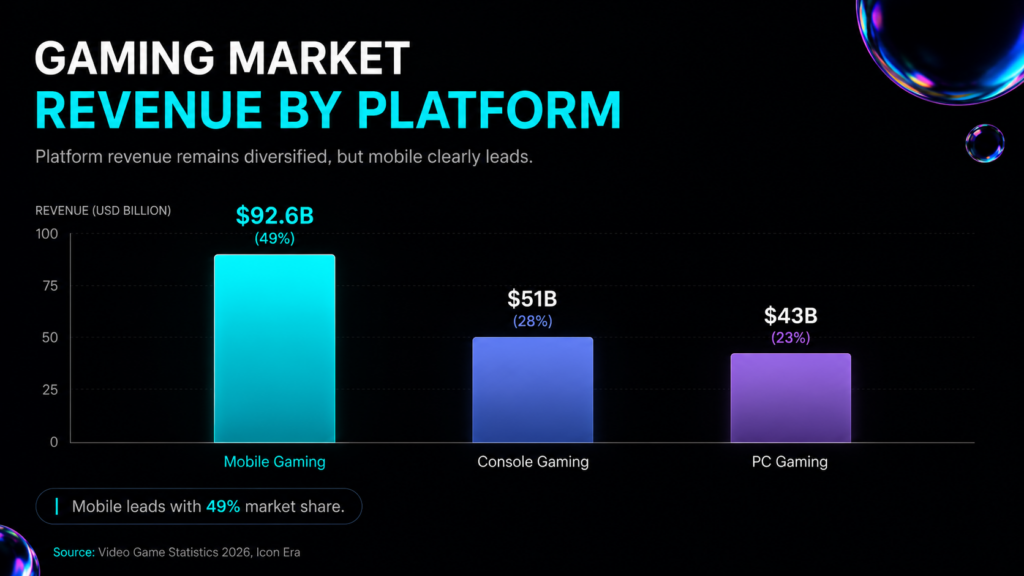
Platform revenue remains diversified but clearly mobile-led:
- Mobile gaming: $92.6B (49% market share)
- Console gaming: $51B (28%)
- PC gaming: $43B (23%)
More than 2 billion players use mobile devices, and smartphones are now the primary gaming device for 68% of global players.
These gaming market statistics confirm two things:
- Gaming is fully mainstream.
- Growth is ecosystem-driven, not hardware-dependent.
The scale is enormous — but the strategic shifts underneath that scale matter even more.
Platform Convergence Is Reshaping the Gaming Industry
One of the defining gaming industry trends heading into 2026 is platform convergence.
According to BCG’s Video Gaming Report 2026, the traditional separation between console, PC, and mobile ecosystems is breaking down. Cloud infrastructure, cross-platform engines, and subscription services are accelerating the transition toward a hardware-agnostic model.
Instead of “console wars,” we are entering an era of ecosystem competition.
The same report indicates that 60% of players have already tried cloud gaming, and 80% of those report a positive experience. The shift is behavioral, not speculative.
For brands, this convergence creates:
- Cross-device reach
- Seamless transitions between screens
- New entry points into gaming sessions
- Greater importance of community over device ownership
Gaming is no longer about a box under the TV. It is about connected digital environments.
Generative AI and the Acceleration of Content Supply
AI is now embedded into the production layer of the gaming industry.
As noted in BCG’s Video Gaming Report 2026, around 20% of new Steam releases disclose the use of AI, double the figure from the previous year. Roughly half of studios are already incorporating AI tools into development workflows.
AI is accelerating:
- Asset production
- Coding efficiency
- NPC intelligence
- Live content management
- Iteration cycles
The result will likely be a dramatic increase in content supply.
But increased supply raises a critical strategic issue: discoverability.
As more titles enter the market, community, algorithmic discovery, and ecosystem positioning become decisive. For brands, that means integration strategies must prioritize contextual relevance — not just exposure.
UGC and the Creator Economy as Growth Engines
User-generated content has evolved into a structural revenue driver.
Creator payouts on major gaming platforms are projected to exceed $1.5 billion in 2025, while a growing share of players report consuming more user-generated content year over year.
Roblox alone generated $1.2 billion in revenue in 2024, fueled by its UGC-driven model (Video Game Statistics 2026, Icon Era).
Games increasingly function as platforms — living ecosystems continuously reshaped by creators and communities.
For marketers, this represents a shift from:
- Static placements → participatory experiences
- Campaign bursts → ecosystem engagement
- Publisher-only influence → community-driven influence
The gaming industry growth story is no longer just about new titles. It is about expanding digital environments.
Cloud Gaming: The Fastest-Growing Revenue Segment
Cloud gaming is emerging as one of the strongest video game market growth drivers.
Cloud services generated $6.4 billion in 2024 and are projected to reach $8.2 billion in 2025, reflecting a 28.1% annual growth rate (Video Game Statistics 2026, Icon Era).
Cloud removes traditional friction:
- No downloads
- No hardware constraints
- Instant access
- Cross-device continuity
As barriers fall, session entry becomes easier. When gameplay can start instantly from a link or ecosystem hub, conversion pathways shorten.
For brands, this opens a new layer of opportunity — especially in environments where frictionless access supports impulse-driven participation.
Distribution Disruption and the App Store Shift
Mobile accounts for nearly half of total gaming revenue, but distribution models are evolving.
BCG’s Video Gaming Report 2026 highlights how regulatory and legal developments are opening app store ecosystems, enabling:
- Alternative payment systems
- Developer-owned web stores
- Reduced commission structures
- Greater monetization control
Survey data cited in the report shows that 33% of adult gamers and 40% of teens have made at least one purchase via developer-owned web stores.
Distribution power is fragmenting. Developers are regaining margin control. Platform dominance is being challenged.
For brands partnering within gaming ecosystems, this means:
- More diversified media environments
- Increased experimentation
- Greater DTC integration potential
Demographics: Gaming Is Fully Mainstream
The stereotype of gaming as youth-only entertainment no longer holds.
Current gaming industry statistics show:
- Average gamer age: 36
- 30% of players are 50+
- 46% of global players are female
The 25–34 segment remains the largest demographic, but participation spans generations.
Gaming is now an intergenerational behavior. Parents introduce children to games. Adults remain active players well into later life stages.
For brands, this expands category relevance far beyond traditional gaming-adjacent sectors. Finance, FMCG, retail, automotive, telco — all have credible entry points into gaming ecosystems.
Monetization Evolution: From Units Sold to Hours Played
Monetization models are also shifting.
In-game purchases generated $71.1 billion in 2024, with continued growth projected into 2025 (Video Game Statistics 2026, Icon Era). Subscription revenues are also expanding as ecosystems mature.
The logic is changing:
- From ownership → access
- From launch-day spikes → lifecycle retention
- From product → platform
Developers increasingly optimize for hours played, not just units sold. Engagement becomes the core metric.
For brands, this changes campaign timing and integration logic. Activations tied to engagement cycles, live events, and community moments outperform one-off launch alignments.
What These Gaming Industry Trends Mean for Brands in 2026
The gaming industry is growing — but more importantly, it is reorganizing.
Three strategic implications stand out:
1. Attention Is Deep, Not Superficial
Gaming sessions last hours. Engagement is immersive. Unlike traditional digital advertising, gaming environments create sustained attention.
2. Ecosystems Matter More Than Titles
As platform convergence accelerates, brands should think ecosystem-first — not placement-first.
3. Community Drives Discoverability
In a world of expanding content supply, community influence becomes the ultimate distribution mechanism.
Gaming market growth in 2026 is not simply about revenue expansion. It is about structural transformation.
Conclusion: Growth Is Back — But the Model Has Evolved
The video game market growth story heading into 2026 is clear:
- $260B global revenue
- 3.49B active players
- Double-digit CAGR toward 2030
- Rapid cloud and subscription expansion
But the deeper story lies in convergence.
Platforms are colliding. AI is accelerating production. UGC is democratizing creation. Distribution is decentralizing. Monetization is shifting toward engagement-based models.
The gaming industry trends defining 2026 are not incremental. They are structural.
For brands, the opportunity is not just to “enter gaming,” but to understand where attention, ecosystems, and monetization are evolving — and position themselves accordingly.