How to Measure Brand Awareness in Live Streaming When 73% of Your Audience Isn’t Watching Passively
A stream campaign reaches 2 million unique viewers across 200 channels. The reporting deck looks strong: high concurrent viewership, thousands of chat mentions, clips circulating on social platforms. Three months later, the brand tracking study comes back inconclusive. The survey used to measure it was built for a 30-second TV spot, not a two-hour stream where the audience is typing, reacting, and deciding in real time what to watch next.
That mismatch shows up constantly, and it is fixable. Brand awareness measurement already has established methods: surveys, brand lift studies, digital proxies, tracking programmes. None of them were designed with live streaming in mind, so applying them unchanged produces numbers that undercount what a campaign actually did. Here is how to measure brand awareness when live streaming is part of the media plan, adjusted method by method rather than bolted onto a framework built for passive video.
Reach and impressions don’t measure what a stream audience remembers
Viewership data confirms delivery. It does not confirm memory. Three numbers get treated as proxies for brand awareness on a stream campaign, and none of them actually measure it:
- Concurrent viewer counts confirm how many people were watching at a given moment, not whether they noticed the brand.
- Unique reach confirms how many distinct viewers a campaign touched, not whether it registered with them.
- VOD view totals confirm replay activity, not recall.
Brand awareness is the percentage of a target population who can recall or recognize a brand, measured directly through research rather than inferred from viewership data. A campaign with 2 million unique viewers can produce a double-digit awareness lift, or none at all, and viewership numbers alone will not tell you which happened. Chat volume and clip counts make a campaign look successful in a reporting deck, but neither one is a measure of memory. Only a direct survey confirms that.
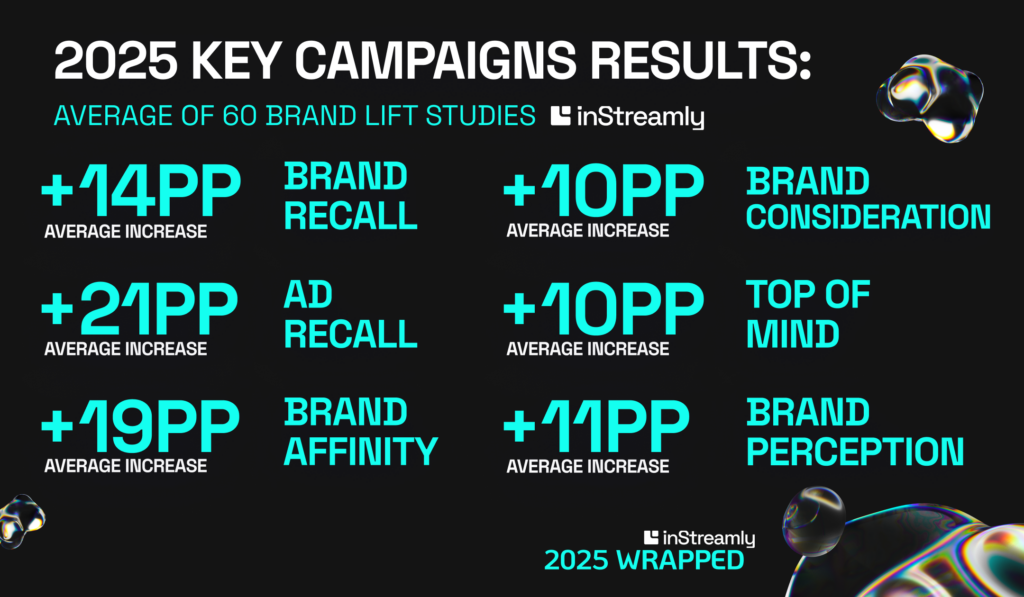
Key inStreamly campaigns results in 2025
How do you run a brand awareness survey for a live streaming audience?
Three KPIs cover most live streaming brand lift programmes, the same three layers inStreamly’s own studies track:
- Ad recall — aided, which brand a viewer remembers seeing advertised in the stream
- Top-of-mind awareness — unaided, the brand named first for the category
- Brand affinity — perception, which brand a viewer associates with supporting creators and the streaming space
Live streaming audiences need the survey itself adjusted, not just the timing. Three factors change what a recall question needs to capture:
- Chat participation changes what “watching” means. On live streaming, 73% of viewers actively participate in chat while a stream runs rather than watching passively, according to our Live Streaming Trends report we conducted last year. A brand moment that lands inside an active chat conversation registers differently than a pre-roll ad a viewer skips, and a standard recall question does not capture that difference.
- Streamer trust adds a layer standard surveys miss. When a streamer mentions or reacts to a brand, 79% of viewers read it as support for the creator rather than as advertising, per the same report. A recall question written for a 30-second spot will not surface that distinction, so add a question about the streamer or channel context alongside the brand question.
- VOD viewing shifts the timing. Part of the audience watches a stream moment back rather than only live, so time the survey to account for replay behavior instead of closing the window right after the broadcast ends.
What does a brand lift study look like for a stream campaign?
A brand lift study compares an exposed group, people who saw the campaign, against a matched control group that did not. Both are surveyed on the same questions, before and after the flight. The comparison isolates what the campaign itself moved, rather than what seasonal attention or category news moved on its own. Our guide to brand lift measurement covers the full study structure and when to bring in a third-party provider versus running the measurement in-platform.
Two things shift the setup for a stream campaign specifically:
- Reach means something different here. Contextual in-stream placements are not served through the external ad networks that blockers intercept, so a livestream brand lift study can capture audiences other channels simply miss. That matters given 64% of gamers run ad blockers on other platforms, per inStreamly’s report.
- Exposure data is already controlled at the platform level. For a single-channel livestream campaign, that often makes a reliable in-platform read possible without a third-party panel, which shortens the time from campaign end to results.
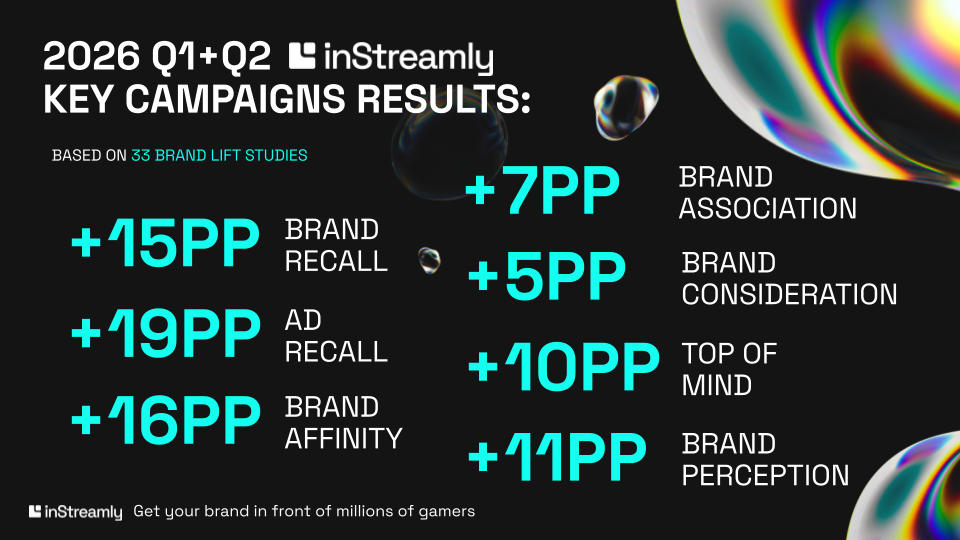
Key inStreamly campaigns results in Q1 and Q2 of 2026
Chat volume and clip activity are livestream-specific proxy signals
Branded search volume, direct site traffic, and social listening all move when brand awareness shifts, and they work for a stream campaign the same way they work for any other channel: as directional confirmation, not as a primary KPI.
What is different on live streaming is the proxy data the format generates on its own:
- Chat message volume tied to a brand trigger. Dr. Oetker’s Guseppe campaign generated 48,000 pizza-related chat messages alongside a 33 percentage point lift in ad recall and an 11 percentage point lift in purchase intent. The chat volume tracked closely with the eventual survey result.
- Clip creation and reshare counts around a brand moment. A spike in clips is not proof of awareness on its own, but it usually points in the same direction the tracking study later confirms.
- Organic streamer mentions. When a phrase or trigger spreads across streams without being scripted into every broadcast, it is a strong early signal worth cross-checking against the survey wave that follows.
Treat all three as supporting evidence. None of them replace the survey. They tell you where to look before the tracking data comes back.
Which KPIs and benchmarks should you set for a live streaming campaign?
Three KPIs cover most brand awareness programmes:
- Unaided awareness percentage – spontaneous recall within the category
- Top-of-mind share – the brand named first, unaided
- Aided recognition percentage – among the target population specifically, not the total market
Benchmarks vary by category and how established a brand already is, so direction and rate of change across waves matter more than any single absolute number. Live streaming campaigns give a useful sense of what is achievable:
| Campaign | Result |
|---|---|
| Cheetos Chepard (220 Twitch streams, 3.2M views) | +11pp brand awareness |
| Knorr Romania | +52pp ad recall, top-of-mind 27% → 72% |
| Łaciate Protein+ | +17pp ad recall, +16pp brand consideration |
| T-Mobile “Fastest Network” | +11pp brand recall, +16pp brand affinity, 10,000+ organic mentions |
Full case details: Cheetos’ Chepard campaign and Knorr’s campaign in Romania. Set targets against benchmarks like these rather than against category averages built from display or TV data.
Building a brand awareness measurement plan for live streaming
A working plan needs five decisions made before a stream campaign launches, not after:
- Define the population. Measure the campaign’s target audience, not the total addressable market.
- Choose survey-based measurement as the primary method. Unaided and aided questions, category asked before brand names.
- Add a live streaming context question. Ask about the streamer or channel alongside the brand, since chat participation and creator trust change how a moment registers.
- Set the cadence. Continuous tracking for always-on spend, quarterly or semi-annual waves for campaign-driven budgets.
- Add channel attribution. Tag responses or run pre- and post-campaign waves around specific flights so any movement can be traced back to the stream campaign specifically.