For BrandsMarketing01.07.2026

What is brand lift and how do you measure it?
A campaign can hit every impression target on the media plan and still leave no mark on how people think about the brand. That gap between delivery and impact is exactly what brand lift measures. It answers a question reach numbers cannot: did anyone’s mind actually change?
For campaign planners, brand lift studies are the difference between reporting “we served 4 million impressions” and reporting “brand recall rose 13 percentage points among people who saw the campaign, compared to a matched group who did not.” One of those numbers proves something happened. The other only proves something was shown.
This guide covers what brand lift measures, how a brand lift study is built and run, which metrics matter for which campaign objective, what real results look like, and how to read the numbers once a study comes back.
What brand lift actually measures
Brand lift is the measurable change in how an audience perceives a brand as a direct result of exposure to advertising. It is not a single number. It is a set of perception shifts, each tracked against a specific question: did the campaign make people more aware of the brand, more likely to remember it, more likely to consider it, or more favorable toward it?
Five metrics make up most brand lift studies:
- Brand awareness: whether people know the brand exists
- Ad recall: whether people remember seeing the specific ad
- Brand recall: whether people can name the brand without a prompt
- Brand consideration: whether people say they would consider buying from the brand
- Brand affinity: whether people feel more favorably toward the brand
Ad recall and brand lift get confused often enough that it is worth separating them clearly. Ad recall asks whether someone remembers the specific creative they saw. Brand lift asks whether the brand’s overall standing improved. A campaign can score high on ad recall (people remember the ad clearly) while showing weak brand lift, if the creative was memorable but did not shift how people feel about the brand behind it.
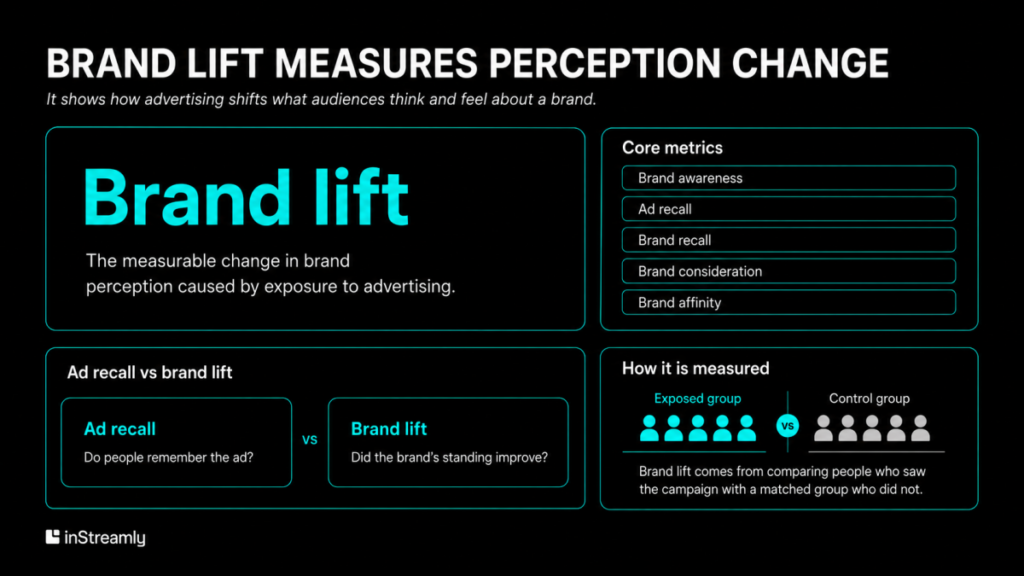
The mechanism behind every brand lift number is comparison. Researchers survey an exposed group, people who saw the campaign, and a matched control group who did not. The control group is not a formality. Baseline awareness, seasonal attention, and category-wide news can all move brand perception on their own. Comparing exposed to control isolates the part of the movement that the campaign itself caused.
How are brand lift studies designed and run?
The standard structure is a survey run against two groups: people exposed to the campaign, and a demographically matched group who were not. Both groups answer the same questions. The difference between their answers, not the raw score of either group, is the lift.
Timing matters more than most planners expect. Surveys typically go out within 24 to 72 hours of exposure. Memory of a specific ad decays fast, and waiting longer introduces noise from other things the person saw or did in between.
Question design depends on what stage of the funnel the study is measuring. Unaided recall questions (“which brands come to mind when you think of X”) work for top-of-funnel awareness. Purchase intent questions (“how likely are you to buy X in the next month”) work for bottom-funnel consideration. Using the wrong question type for the objective produces a technically valid number that answers the wrong question.
Sample size determines whether the result means anything. A brand lift study typically needs 500 or more respondents per group to reach statistical significance. Below that threshold, a 5-point swing could easily be noise rather than signal.
Search volume uplift and direct traffic lift can supplement a brand lift study, but they are secondary signals. They correlate with brand interest, but they do not isolate causation the way a matched control group does.
Different campaign objectives call for different brand lift metrics
The metric has to match the objective, or the study measures the wrong thing.
- Awareness campaigns: track unaided brand awareness and brand recall. The goal is getting into the consideration set, so the study should measure whether more people know the brand exists and can name it unprompted.
- Consideration campaigns: track brand familiarity and purchase intent. The goal is moving people from knowing the brand to actively weighing it, so awareness metrics alone will not show whether that happened.
- Brand affinity campaigns: track brand favorability and likelihood to recommend. The goal is emotional connection, not just recognition, so recall metrics will understate the campaign’s actual effect.
The most common mistake is tracking ad recall as the headline metric for a campaign whose actual goal was brand affinity. A campaign can score a strong ad recall lift and still fail its real objective, because a memorable ad is not the same as a brand people feel warmer toward.
A quick way to check before a campaign launches:
- Does the campaign objective map to awareness, consideration, or affinity?
- Does the study’s primary metric match that objective?
- Are secondary metrics included to catch unexpected effects, without diluting the primary read?
- Is the sample size large enough for the smallest audience segment being measured?
What do brand lift results look like from live streaming campaigns?
Numbers from real campaigns give planners a sense of scale, what a strong result actually looks like rather than a theoretical range.
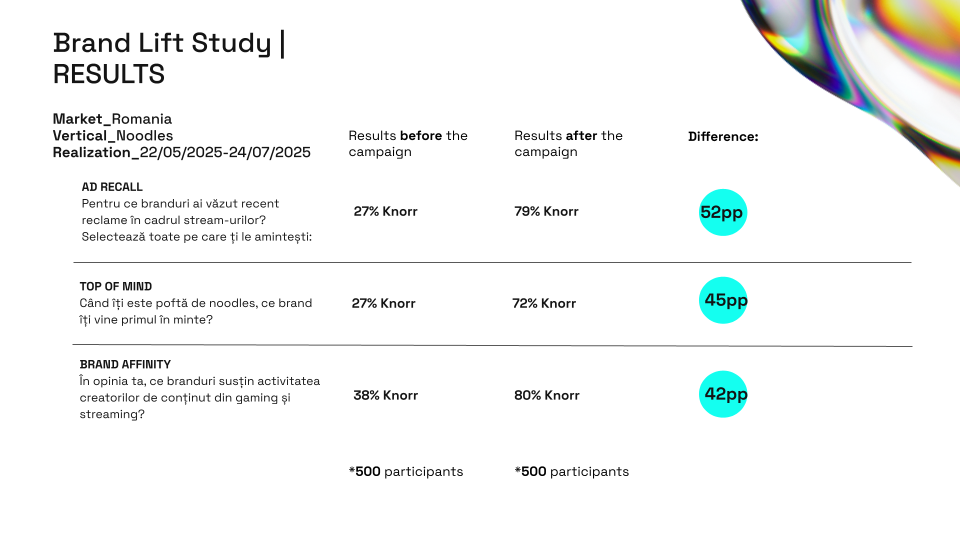
A Knorr voice recognition campaign run through inStreamly in Romania produced a 52 percentage point lift in ad recall and a 45 percentage point lift in top-of-mind awareness. The campaign triggered branded animations when streamers said specific keywords on air, timing the brand’s appearance to the exact moment viewers were already paying attention to that topic.
T-Mobile’s “The Fastest Network” campaign generated a 16 percentage point lift in brand affinity and an 11 percentage point lift in brand recall. The phrase was said organically by streamers more than 10,000 times over the course of the campaign, without the brand paying for each individual mention. Streamers said it because it fit naturally into their commentary, not because a script required it.
Dr. Oetker’s Guseppe campaign used personalized creative, nearly 1,900 unique ad variations tailored to individual streamers, and produced a 33 percentage point lift in ad recall alongside an 11 percentage point lift in purchase intent.
The pattern across all three is consistent: the lift is largest when the brand’s appearance is tied to something the viewer is already engaged with, whether that is a spoken keyword, a live game event, or a personalized creative moment. That contextual fit is the mechanical reason live streaming brand lift results tend to run well above what interruptive formats produce. Viewers are not being asked to shift attention toward the ad. The ad shows up inside attention that already exists.
When to run a brand lift study, and who should run it
Any campaign with reach large enough to hit the sample size threshold for statistical significance is a candidate for a brand lift component. Below that reach, the study will not produce a reliable number no matter how well it is designed.
Live streaming campaigns are particularly well suited to this kind of measurement because exposure can be isolated at the individual streamer or viewer level. That precision makes it straightforward to build a clean exposed-versus-control split, something broader formats like linear TV or open-web display struggle to do with the same accuracy.
The standard structure for a live streaming brand lift study follows the same shape as any other: a baseline survey before the campaign, a post-campaign survey among exposed viewers, and a matched control group who did not see the campaign. Studies typically test across the same three layers: top-of-mind awareness, ad recall, and brand affinity, so the results map directly back to the metrics covered earlier in this guide.
Third-party measurement adds independent credibility, particularly for larger or cross-platform budgets. Happydemics is one provider running validated brand lift studies across multiple channels using a consistent methodology, which makes it possible to compare a live streaming campaign’s lift against a display or CTV campaign on equal terms. Nielsen also runs brand lift research across a range of formats. For single-channel live streaming campaigns where exposure data is already controlled at the platform level, in-platform measurement can produce a reliable read without the added cost of a third-party study.
Timing matters here too. Measurement should begin while the campaign is still running, not after it ends. Starting late means the control group has had more time to be organically exposed to the brand through other channels, which erodes the cleanliness of the comparison.
How do you interpret and act on brand lift results?
A lift number on its own does not tell the full story. Context changes what the number means.
Absolute lift and relative lift are not the same thing, and conflating them leads to bad conclusions. A 10 percentage point lift on a 20% baseline roughly doubles the metric. A 10 percentage point lift on an 80% baseline is a smaller relative shift, even though the raw number is identical. Always check the baseline before judging whether a lift is strong.
Segmentation matters as much as the headline figure. A campaign can show solid overall lift while the actual shift is concentrated entirely outside the intended target audience. If the goal was reaching adults 18 to 34 and most of the lift shows up in an older segment, the campaign is not doing the job it was bought to do, regardless of what the topline number says.
Attribution is the harder question once multiple channels run at once. If a brand runs live streaming alongside display and social in the same window, the brand lift study should be designed to show which channel drove the most lift per dollar spent, not just that lift happened somewhere in the mix.
A practical workflow for turning results into decisions:
- Compare the lift against the baseline to judge relative, not just absolute, movement
- Segment results by target audience to confirm the lift landed where it was supposed to
- Cross-reference lift against spend by channel, if multiple channels ran concurrently
- Feed the result back into the next campaign’s creative and targeting decisions, rather than filing it as a one-off report
Brand lift studies are only useful if the read changes what happens next. A study that confirms a strong result but does not inform the following quarter’s media plan is a wasted measurement budget.
Key takeaways
- Brand lift measures the change in perception a campaign causes, isolated through a matched exposed-versus-control comparison, not a single self-reported score
- The metric tracked has to match the campaign objective: awareness metrics for awareness campaigns, affinity metrics for affinity campaigns, or the study will answer the wrong question
- Live streaming campaigns can produce brand lift results well above typical benchmarks when the brand’s appearance is tied to something the viewer is already paying attention to, as seen in results from Knorr, T-Mobile, and Dr. Oetker campaigns
- A lift number is only actionable once it is checked against baseline, segmented by target audience, and fed back into the next campaign’s planning