For BrandsMarketing04.08.2026

Brand Awareness Explained: What It Is, Why It Matters, and How Live Streaming Builds It Differently
A media buyer runs a survey after a campaign and sees awareness numbers move. The client is happy. Nobody asks which kind of awareness moved, or whether it changes what gets purchased. That gap is where media plans quietly waste budget.
Brand awareness is not one number. It is a set of distinct mental states, each requiring a different kind of exposure to build. Treating them as interchangeable is why campaigns that hit their awareness target still fail to move sales.
What brand awareness actually is, and the three forms it takes
Brand awareness is a consumer’s ability to recognize or recall a brand within a product category. That definition splits into three measurable levels, each demanding a different strategy.
Aided awareness is recognition prompted by a cue. A survey asks “have you heard of this brand?” and shows a logo or name. This is the easiest level to achieve and the weakest signal of purchase behavior on its own.
Unaided awareness is spontaneous recall. The question is open: “which brands of this product can you name?” No prompt, no list. A brand that surfaces here has earned a place in memory strong enough to come up without help.
Top-of-mind awareness is the first brand named in unaided recall. It is the most competitive and valuable position in the category, the brand a consumer reaches for before considering anyone else.
The distinction matters: each level needs a different media approach. Aided awareness responds to reach: enough impressions across enough channels. Unaided and top-of-mind respond to something harder to buy: distinctiveness and repeated, memorable context. A brand can score well on aided awareness and still lose every purchase decision to a competitor who owns top-of-mind.
Why does brand awareness decide which brands even get considered?
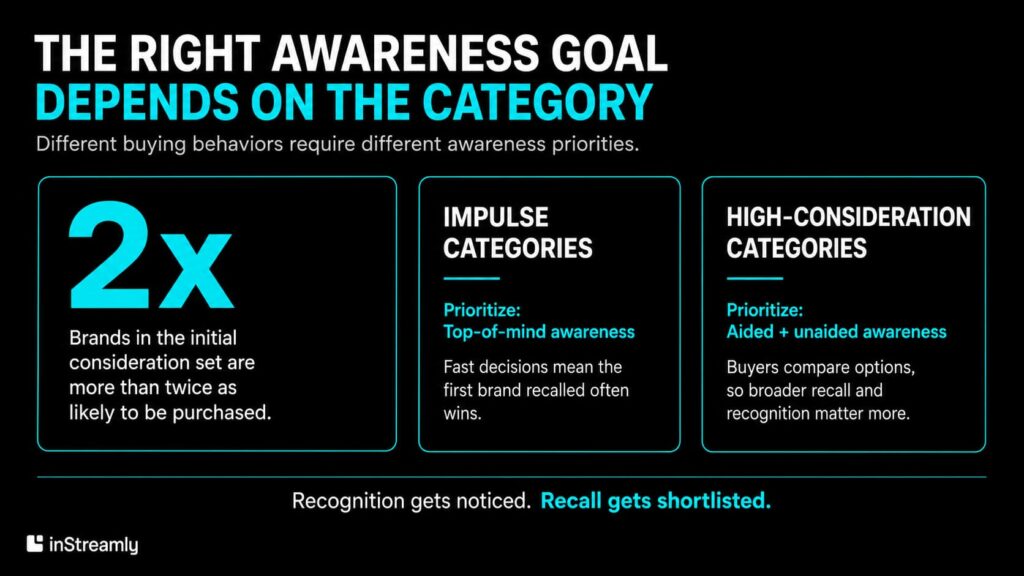
Because it determines which brands even reach the point of comparison. Purchase decisions do not start with a full market scan. They start with a short list of brands a consumer recalls unprompted, the initial consideration set.
- According to McKinsey’s research on the consumer decision journey, brands in that initial set are more than twice as likely to be purchased as brands considered only later, once a buyer starts actively comparing options.
- Brands outside that initial set are not rejected. They are simply never evaluated. No amount of product quality can compensate for a decision that never reaches the comparison stage.
This split plays out differently by category:
- Impulse categories (snacks, drinks, casual apps): the consumer decides in seconds, so only the brand that surfaces first gets picked. Top-of-mind recall is everything.
- High-consideration categories (electronics, financial services, cars): buyers actively research and compare, so broader aided awareness matters more.
Knowing which pattern applies to a category changes what a brand should prioritize. A snack brand chasing aided awareness numbers is measuring the wrong thing entirely.
What actually builds brand awareness, and what doesn’t
Two mechanisms build durable brand awareness, and one popular tactic works against it.
- Reach and frequency in the right context. Consistent exposure delivered in moments that feel relevant, not intrusive, moves a brand from unknown to recognized to recalled. Frequency without relevance just trains an audience to tune out.
- Distinctive creative. Brands that look, sound, or behave differently from category norms get remembered. Generic executions blend into noise consumers have already learned to filter.
- What doesn’t work: high-frequency interruptive advertising served to audiences filtering it out. Roughly 64% of stream viewers use ad-blocking tools, according to our Live Streaming Trends 2025 report. Every impression bought against that share never renders. The dashboard reports delivered impressions. The consumer never sees the ad.
Why does live streaming build brand awareness differently from display advertising?
Because it reaches viewers in an attentive state instead of interrupting them.
According to the same Live Streaming Trends 2025 report:
- 62% of livestream viewers have abandoned traditional TV entirely. A legacy TV or pre-roll plan cannot reach them by spending more. They have already left the channel.
- 73% of stream viewers actively participate in chat rather than watch passively. A viewer typing in chat is in an engaged, attentive state, not a distracted one scrolling past an autoplay video.
When a brand appears as part of that environment rather than interrupting it, the exposure gets encoded differently in memory. It sits alongside content the viewer chose, delivered by a creator they follow, at a moment that fits what is happening on screen. That is why live streaming reaches audiences other formats miss entirely.
Two campaigns that prove the pattern
The theory holds up against actual results.
- Cheetos Chepard put a custom Tamagotchi-style virtual pet inside 220 simultaneous Twitch streams, letting viewers feed it and shape its development through chat commands. The campaign drew 3.2 million views and an 11 percentage point lift in brand awareness. Viewers asked for a sequel once it ended, a response interruptive advertising rarely earns. Details are in the Cheetos Chepard case study.
- PKO Bank Polski built a branded educational map inside Fortnite and saw an average session length of 26 minutes per visitor, extraordinary for any digital ad format. A financial brand with no natural home in gaming became a destination players chose to spend time inside. Details are in the PKO Bank Polski case study.
The pattern across both: brands that integrate into content viewers want get recalled. Brands that interrupt it get ignored or blocked.
How does brand awareness differ from recognition, recall, and consideration?
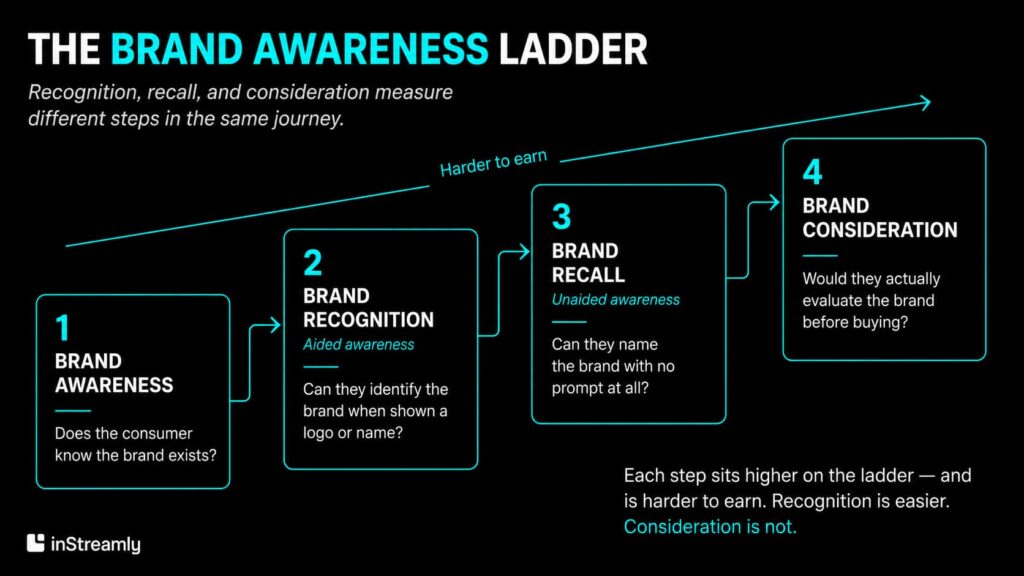
These four terms get used interchangeably, but each measures a different point on the same ladder.
- Brand awareness: the umbrella term. Does the consumer know the brand exists at all?
- Brand recognition: aided awareness. Can they identify the brand when shown a cue like a logo or name?
- Brand recall: unaided awareness. Can they name the brand with no prompt at all?
- Brand consideration: a step beyond recall. Would they actually evaluate the brand before buying?
Checklist: which metric should you prioritize right now?
- New to a market: prioritize aided awareness and recognition. Nobody recalls what they’ve never seen.
- Established but stuck: prioritize unaided recall and top-of-mind. Recognition alone won’t move a plateaued brand.
- Entering a campaign cycle: prioritize consideration set inclusion, closest to purchase behavior.
- Comparing channels: match the metric to how your category shops. Impulse needs top-of-mind. High-consideration needs reach.
Key takeaways
- Brand awareness splits into three measurable levels, aided, unaided, and top-of-mind, each needing a different media strategy.
- Brands in a consumer’s initial consideration set are more than twice as likely to be purchased than brands considered later, making early awareness a purchase-driving metric.
- Ad blockers filter out a meaningful share of interruptive advertising before it renders, while contextual integration in live streaming reaches an engaged, attentive audience.
- Cheetos Chepard drove an 11 percentage point awareness lift across 220 simultaneous streams. PKO Bank Polski earned 26-minute average sessions in a category with no natural gaming presence.