inStreamly NewsFor Brands03.02.2026
inStreamly 2025 Wrapped: Building Attention-First Marketing at Global Scale
2025 was the year when the attention economy stopped being a theory and became an operational reality.
Across marketing teams worldwide, the same challenges kept resurfacing: rising media costs, declining effectiveness of traditional formats, and audiences increasingly resistant to interruption. For brands trying to reach Gen Z and younger consumers, the problem was no longer how to buy more reach, but how to earn meaningful attention.
At inStreamly, 2025 became a year of scaling this mindset in practice. From campaign execution and creator monetization to market education and global presence, we focused on building attention-first gaming marketing at real scale.
Why 2025 mattered: when the attention economy became unavoidable
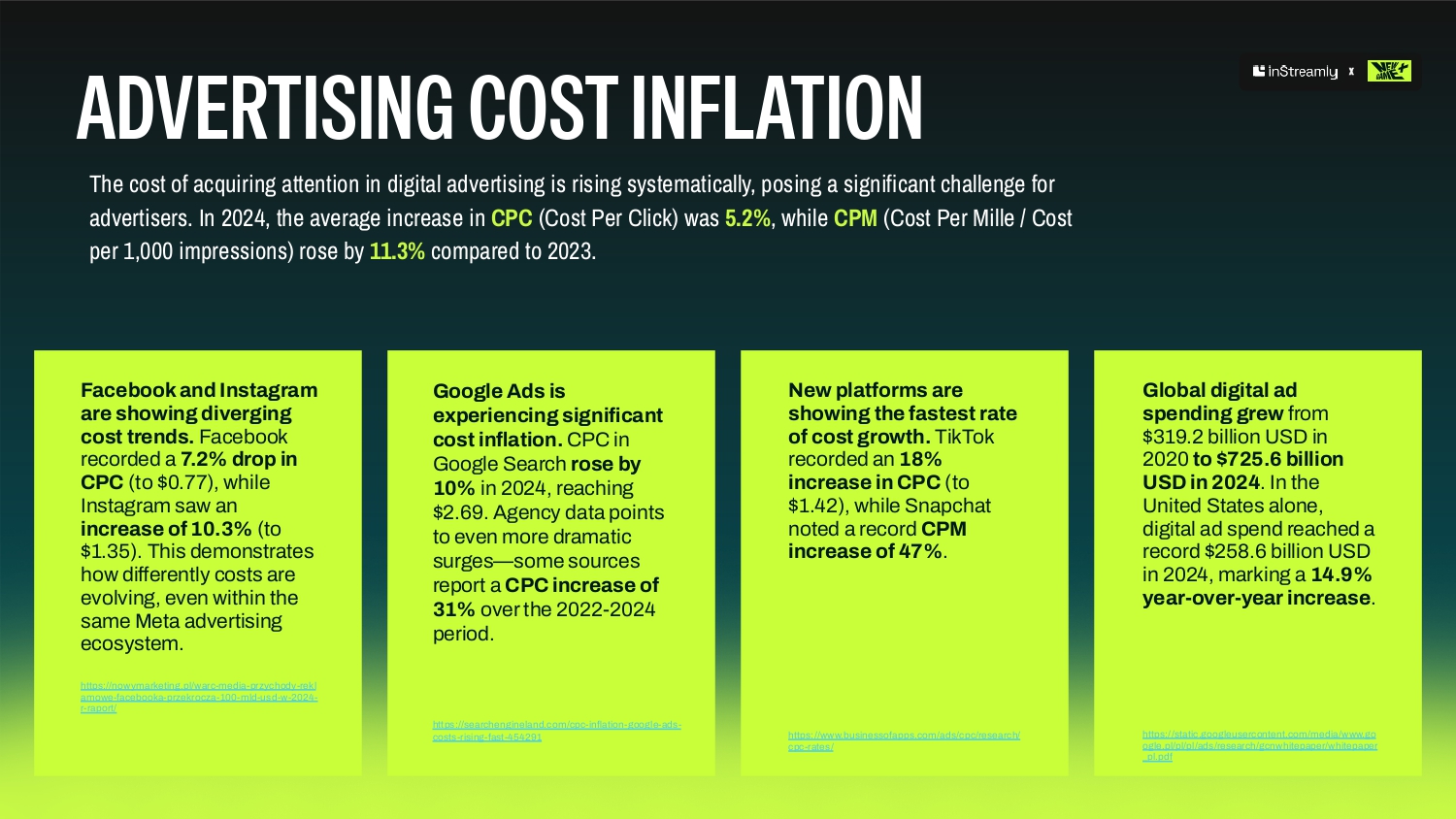
According to our Attention Economy research developed within New Game +, the structural pressure on traditional digital advertising intensified further in 2025. Average CPC increased by 5.2% year over year, CPM by 11.3%, while Gen Z audiences continued to disengage from interruptive formats. With an average attention span of just 1.3 seconds(!) and widespread ad blocker usage, classic performance metrics became increasingly disconnected from real impact.
At the same time, gaming and live streaming continued to stand out as environments where attention is measured in minutes, not milliseconds. Livestreaming, in particular, remains one of the few digital contexts where audiences voluntarily stay present, emotionally engaged, and open to brands that understand the culture they are entering.
2025 was the year when this contrast became impossible to ignore. For us, it was also the year when attention-first marketing moved from isolated executions to a scalable operating model.
👉 Check the full Attention Economy research here: https://newgameplus.group/pl/zasoby/ekonomia-uwagi
2025 in numbers: attention delivered at scale
In 2025, inStreamly delivered 331 commercial campaigns across its direct and partner ecosystem.
- 216 campaigns were led directly by inStreamly
- 115 campaigns were executed through our partner ecosystem
- Together, these campaigns generated 137,217,465 total views
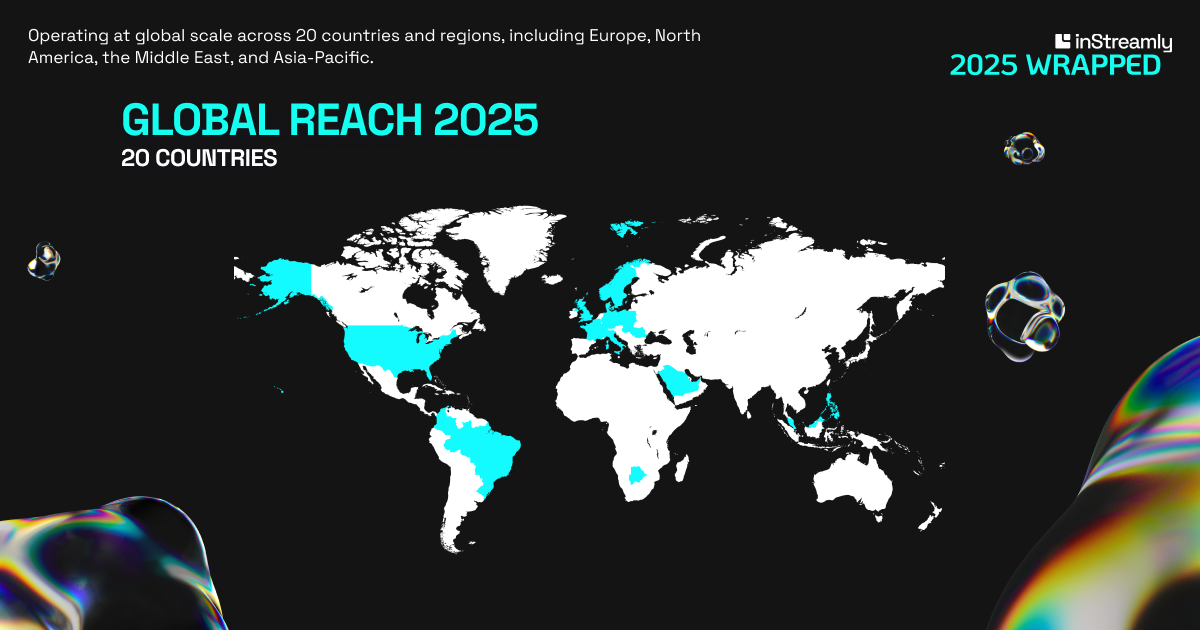
Our activities spanned 20 countries and regions, including Europe, North America, the Middle East, and Asia-Pacific. Long before announcing global expansion plans, attention-first gaming marketing was already operating at international scale.
Brand impact across the full funnel
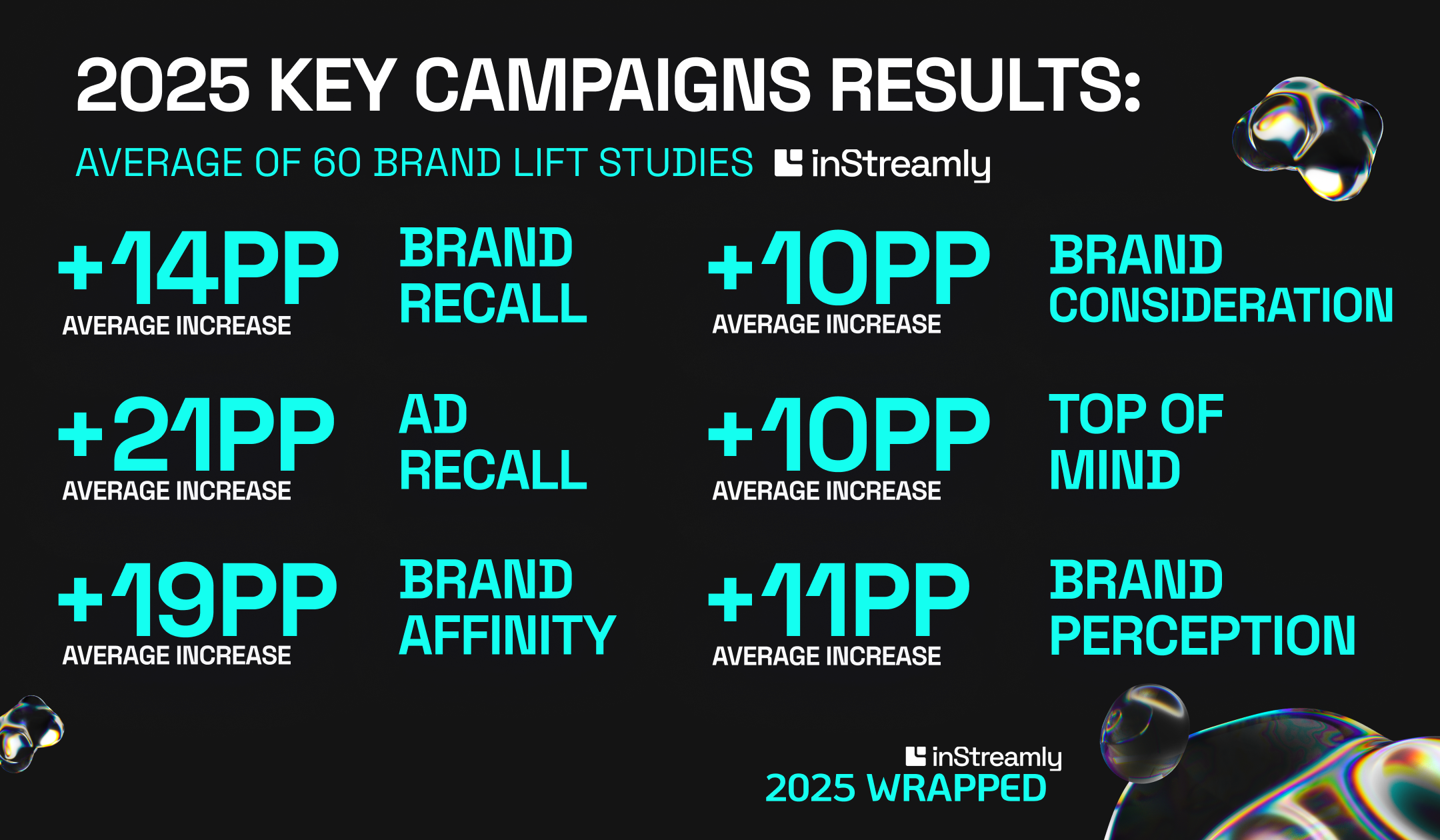
Beyond reach, 2025 provided strong evidence that contextual, non-intrusive gaming formats drive measurable brand outcomes. Based on an average of 60 Brand Lift Studies, campaigns delivered the following uplifts:
- +21 pp Ad Recall
- +14 pp Brand Recall
- +10 pp Brand Consideration
- +11 pp Brand Perception
- +10 pp Top of Mind
- +19 pp Brand Affinity
These results consistently covered the entire funnel, from initial awareness to emotional connection, reinforcing the idea that attention earned through context performs better than attention forced through interruption.
Gaming as a creator economy built with inStreamly
In 2025, the creator economy around inStreamly campaigns reached a scale that clearly shows how attention-first gaming marketing translates into real value for creators.
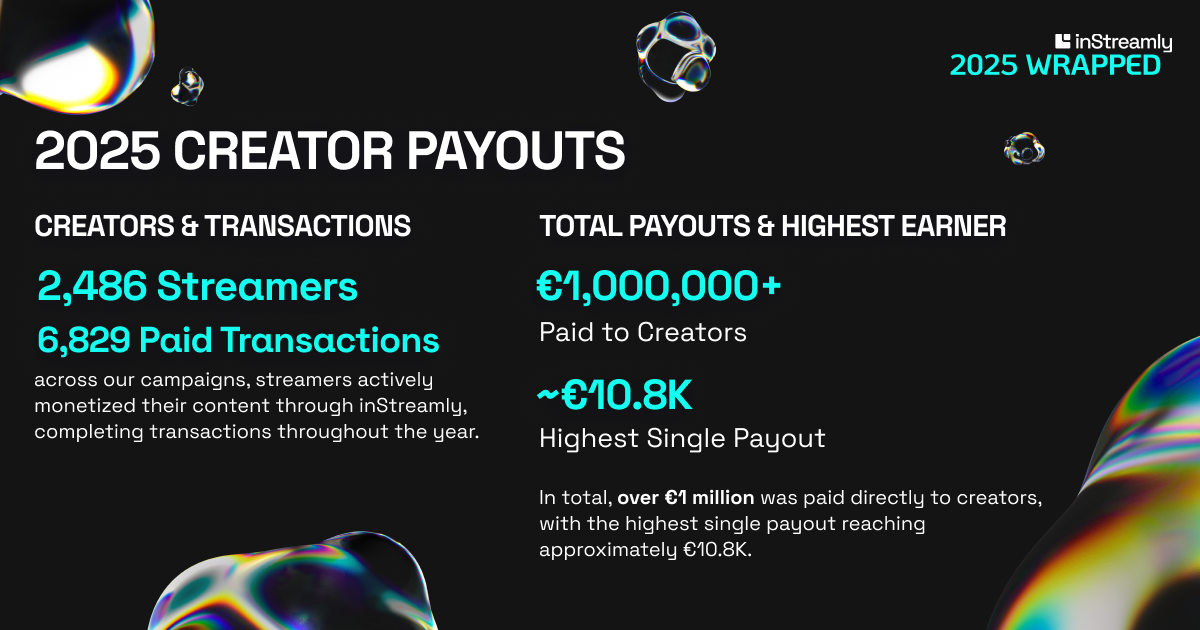
Across our campaigns, 2,486 streamers actively monetized their content through inStreamly, completing 6,829 paid transactions throughout the year.
In total, over €1 million was paid directly to creators, with the highest single payout reaching approximately €10.8K.
These results reflect more than campaign volume. They show how an attention-first approach, when executed at scale, can create a sustainable monetization layer for streamers participating in brand campaigns. Instead of treating creators as interchangeable media placements, inStreamly campaigns are designed to reward long-term engagement, contextual relevance, and genuine community interaction — aligning brand objectives with the economic realities of the streaming ecosystem.
Our 2025 case studies: campaigns that earned attention
In 2025, attention-first marketing at inStreamly was proven in practice through campaigns delivered for brands across multiple categories. The following case studies show how contextual gaming activations translated strategy into real attention, engagement, and cultural relevance—by fitting naturally into gameplay rather than interrupting it.
Go2Warsaw – City of Wonders in Fortnite
Instead of promoting Warsaw through conventional tourism advertising, City of Wonders invited players to experience the city inside Fortnite. The campaign replaced exposure with exploration, allowing players to discover Warsaw-inspired stories, environments, and cultural references through gameplay.
This approach reflected a broader shift in destination and place marketing: attention grows when brands create worlds audiences want to spend time in, not when they interrupt existing ones.
PKO Bank Polski – banking education in Fortnite
PKO Bank Polski’s Fortnite activation redefined what educational brand engagement can look like in gaming. Rather than promoting products, the campaign focused on financial literacy delivered through gameplay.
The result was an average session time of 26 minutes, 590,000 map views, and hundreds of thousands of minutes of voluntary engagement. In a market where attention is often measured in seconds, these results demonstrated the value of designing experiences instead of ads.
Guseppe by Dr. Oetker – personalization that sparked community interaction
Guseppe by Dr. Oetker entered gaming culture by turning food choice into a shared community experience. Using inStreamly’s Streamer’s Choice mechanism, nearly 1,900 streamers publicly endorsed their favorite pizza variant, triggering organic chat discussions and playful “pizza tribes.” The campaign delivered strong brand impact: +10 pp brand perception as “pizza for gamers,” +11 pp purchase consideration, and +33 pp ad recall—proving that personalization at scale can earn attention without interrupting gameplay.
Knorr – turning instant noodles into a perfectly timed gaming power-up
Knorr reframed its instant noodles as an in-game solution rather than a traditional ad. By combining Streamtime Counter and Dynamic Copy, contextual overlays appeared during long gaming sessions, positioning noodles as timely “power-ups.” The result was exceptional Brand Lift performance: +52 pp Ad Recall, +45 pp Top of Mind, and +42 pp Brand Affinity—showing how precise timing and cultural relevance can make FMCG brands feel native to gaming.
Algoflex – Pain Ambassadors
Algoflex’s Pain Ambassadors campaign, led by our partners, showed how deeply contextual gaming integrations can resonate when they align with in-game behavior and culture — with inStreamly’s technology playing a key enabling role. By turning overlooked NPC characters into health advocates and activating them through voice recognition, the campaign blended education with gameplay in a way that felt natural to viewers.
The results were significant: over 21,600 hours of screen time, reach exceeding 59% of Hungary’s gaming population, and multiple top honors at the Hipnózis Awards 2025, including Best Work of the Year. The campaign stands as a strong example of how well-executed, partner-driven activations — supported by contextual technology — can outperform traditional authority-led messaging.
Building the foundations behind scalable gaming marketing
While campaign outcomes remain the most visible layer of gaming marketing, a major focus of 2025 was strengthening the foundations required to scale campaigns efficiently across platforms, partners, and markets. As the ecosystem expanded, priority shifted toward ensuring that operations, data flows, and internal processes could support higher volumes without sacrificing clarity or control.
We enhanced reporting and data structures to deliver greater precision, consistency, and usability in day-to-day decision-making. By standardizing data validation, refining traffic quality mechanisms, and improving attribution logic, teams gained a clearer understanding of performance drivers and were able to compare campaigns more reliably across channels and timeframes. These improvements enabled faster reactions, more confident optimizations, and better alignment between operational and commercial goals.
At the same time, workflows for creators and partners were streamlined, manual effort was reduced, and organically grown processes were simplified. The result was a more resilient and predictable system – designed to support a growing number of campaigns, markets, and stakeholders, and ready to scale further in 2026 without increasing operational complexity.
We enhanced reporting and data structures to deliver greater precision, consistency, and usability in day-to-day decision-making. By standardizing data validation, refining traffic quality mechanisms, and improving attribution logic, teams gained a clearer understanding of performance drivers and were able to compare campaigns more reliably across channels and timeframes. These improvements enabled faster reactions, more confident optimizations, and better alignment between operational and commercial goals.
At the same time, workflows for creators and partners were streamlined, manual effort was reduced, and organically grown processes were simplified. The result was a more resilient and predictable system – designed to support a growing number of campaigns, markets, and stakeholders, and ready to scale further in 2026 without increasing operational complexity.
Gaming in 2025: the market context behind our growth
Our internal results aligned closely with broader market dynamics captured in the 2025 Gaming Report.
- Global in-game advertising spend reached $8.5B, growing 29.5% year over year
- 92% of Gen Z reported using gaming as a way to manage stress and anxiety, reinforcing its emotional significance
- Streamers increasingly rival traditional broadcasters, with creators like Ibai Llanos reaching 9.1 million concurrent viewers
The report highlights how gaming has evolved into a mainstream cultural platform, attracting non-gaming sectors such as FMCG, banking, retail, and pharma. For marketers, this shift reinforces a key takeaway: gaming is no longer an experimental channel. It is a core environment where attention is formed, shared, and sustained.
👉 Get your copy of 2025 Gaming Report here: https://instreamly.com/learning/2025-gaming-report/
Sharing our learnings beyond campaigns
In 2025, our work went beyond delivering campaigns. We actively shared insights, challenges, and real-world learnings with the wider marketing and gaming ecosystem, contributing to the conversation on how brands can operate more effectively within gaming culture.
Wiktoria Wójcik: building innovation beyond slide decks
Throughout the year, Wiktoria Wójcik represented inStreamly and New Game+ at major global and local industry events, including GDC, Pocket Gamer Connects, Shoptalk, IAB PlayFronts in the US, and Forum IAB Poland. Her talks focused on the realities of building marketing innovation from a startup perspective — from early ideas and experimentation to products used by global brands.
At Forum IAB Poland, Wiktoria and co-founder Szymon Kubiak highlighted gaming not as a niche entertainment space, but as a cultural force and a strategic channel that increasingly shapes how modern brands connect with audiences.
Filip Vukić: scaling streamer communities with trust and context
At the Game Industry Conference in Poznań and during Poznań Game Arena, Filip Vukić shared inStreamly’s practical experience in building and scaling streamer communities across Europe and the US. His sessions focused on the importance of credibility, cultural understanding, and long-term relationships when working with creators at scale.
Continuous analysis: staying close to how audiences evolve
Campaign execution is only one part of the equation. Throughout 2025, we also focused on staying close to how audiences, platforms, and cultures evolve — especially as generational behaviors continue to shift faster than marketing playbooks.
Alongside larger reports and market summaries, we regularly shared shorter analytical pieces exploring how different generations engage with media, brands, and gaming culture, including perspectives on Gen Z vs. Millennials and early signals around Gen Alpha. These publications are part of our ongoing effort to translate changing behaviors into practical marketing understanding, rather than treating insights as one-off discoveries.
What’s next: scaling the foundation we built
With New Game+ proven in the Polish market, the next phase focuses on scaling our approach internationally while continuing to strengthen the underlying infrastructure that supports contextual, non-intrusive marketing in gaming. The priorities ahead center on deeper measurement, smarter moderation and safety, more advanced analysis of content and conversations, and better tools for partners, creators, and brands to operate at scale with confidence.
Rather than chasing isolated innovations, our focus for 2026 is clear: refine what already works, expand it responsibly, and make attention-driven gaming marketing easier to measure, manage, and scale across markets.
Stay close to how gaming marketing really works
If you want to follow how gaming marketing evolves in practice, we share our learnings regularly through our newsletter.
Already over 5,000 marketers subscribe to receive insights based on real campaigns, real data, and real market shifts.
👉 Subscribe to the inStreamly newsletter here: https://instreamly.com/newsletter/
![Which Live Streaming Platform Pays The Most? [2026]](https://wordpress-instreamly.s3.eu-west-2.amazonaws.com/wp-content/uploads/2023/01/13102041/medium-shot-gamer-playing-computer-2-1.jpg)