For BrandsLive stream industry16.06.2026
Twitch Ads in 2026: Formats, Costs, and What Actually Works for Brands
Most brands plan their first Twitch campaign the same way. They open the ad manager, compare formats, check the CPM, and build a media plan around the cheapest route to a thousand impressions. The campaign goes live, and the brand lift study comes back flat.
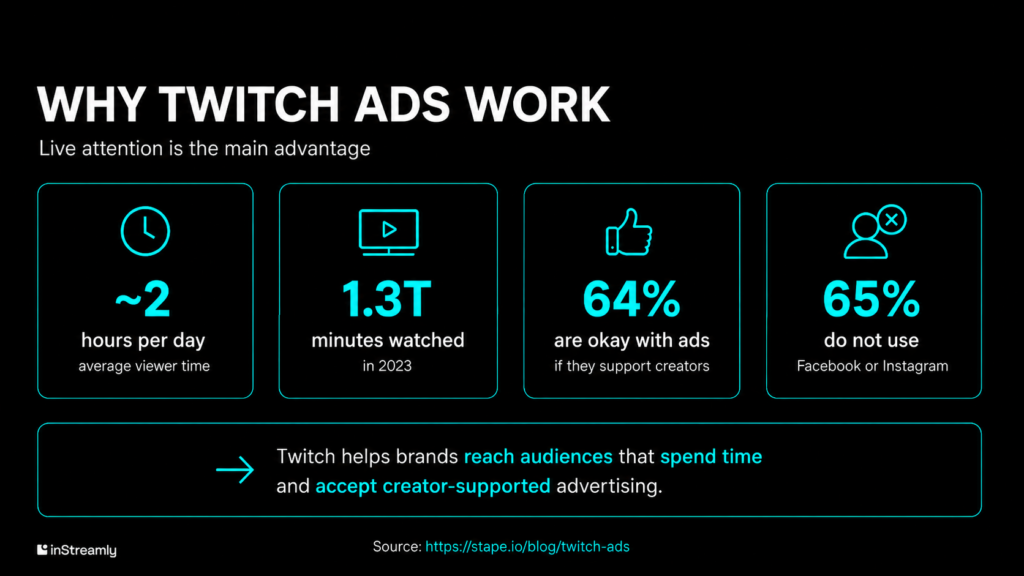
The problem is rarely the creative. A large share of the audience a brand pays to reach on Twitch never loads the ad. Around 64% of gamers use ad-blocking tools, and the standard formats most brands buy are the ones blockers were built to stop. The impression count stays healthy while actual exposure quietly drops. Knowing what each format costs, who it reaches, and where it falls short is what separates a campaign that registers from one that bills cleanly but lands on nobody.
What the four standard Twitch ad formats actually are
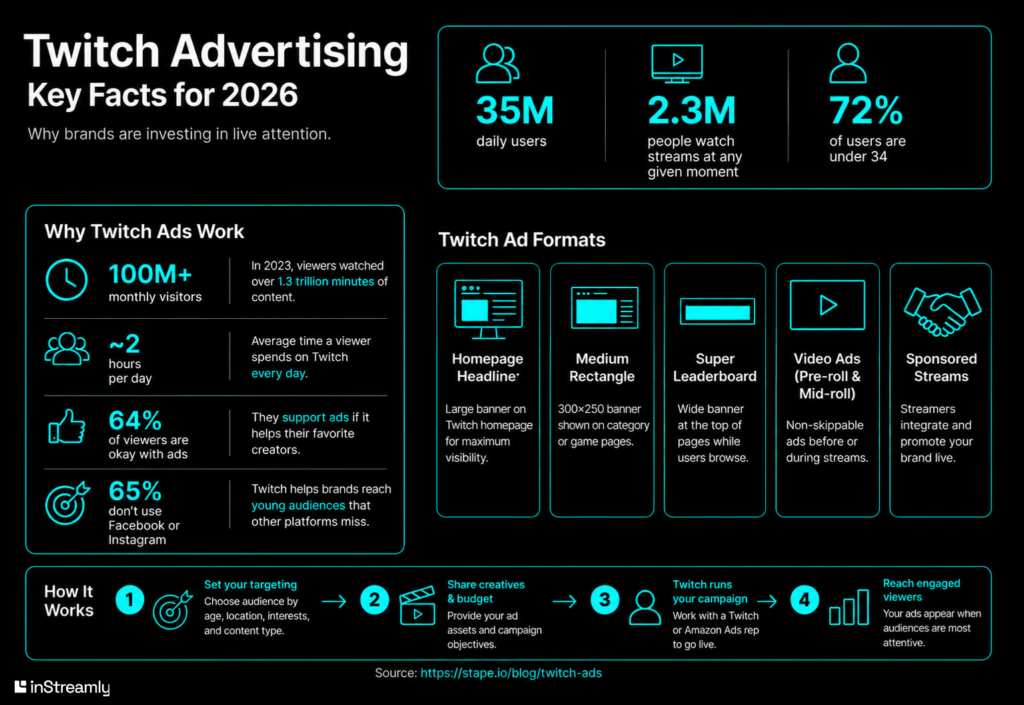
Twitch sells four native ad formats. Pre-roll runs when a viewer first clicks into a stream, before the live content loads. Mid-roll runs during the broadcast, scheduled or triggered manually during a break. Both are video spots. Display banners sit around the stream player, and video overlays appear on top of it while the stream continues underneath.
All four are bought programmatically. According to Stape’s 2026 breakdown, Twitch does not use fixed pricing or sell specific placements. Brands buy impressions through a CPM model and the system distributes them across inventory. You are buying a volume of views, not a streamer or a moment.
One technical detail matters more than the format names. Twitch moved to server-side ad insertion as its default between 2020 and 2022, a response to ad blocking, as Beta Ads documents. That made standard ads harder to block, but it did not change the behavior underneath. The audience that installs blockers also tends to avoid the formats those blockers target.
How much do Twitch ads cost in 2026?
Twitch pricing runs on CPM, the cost per thousand impressions. Stape reports a typical range of $2 to $10, rising for premium targeting and peak periods.
Format and timing move the number. Mid-roll ads carry roughly 15 to 20% higher CPM than pre-roll because they reach a viewer already committed to the stream. Seasonality pushes it further: CPM peaks in Q4, where U.S. rates can reach an average of $8 to $12 from October through December, close to double the annual average. Geography is the other major variable, since the price tracks the value of the viewer rather than the location of the advertiser.
Direct deals with streamers sit outside this system. There is no programmatic CPM and no standard rate card. Pricing is negotiated per creator, based on audience size, category, and the scope of the integration.
Why do standard Twitch formats underperform with gaming audiences?
The people Twitch is best at reaching are the people most likely to filter advertising out.
Ad blocking is highest among the exact demographic gaming brands chase. On desktop, the 18 to 24 cohort runs around 60% ad blocker usage in some datasets, and gaming audiences sit above the general population. The inStreamly Live Streaming Trends 2025 data puts gaming ad blocker usage above 60%.
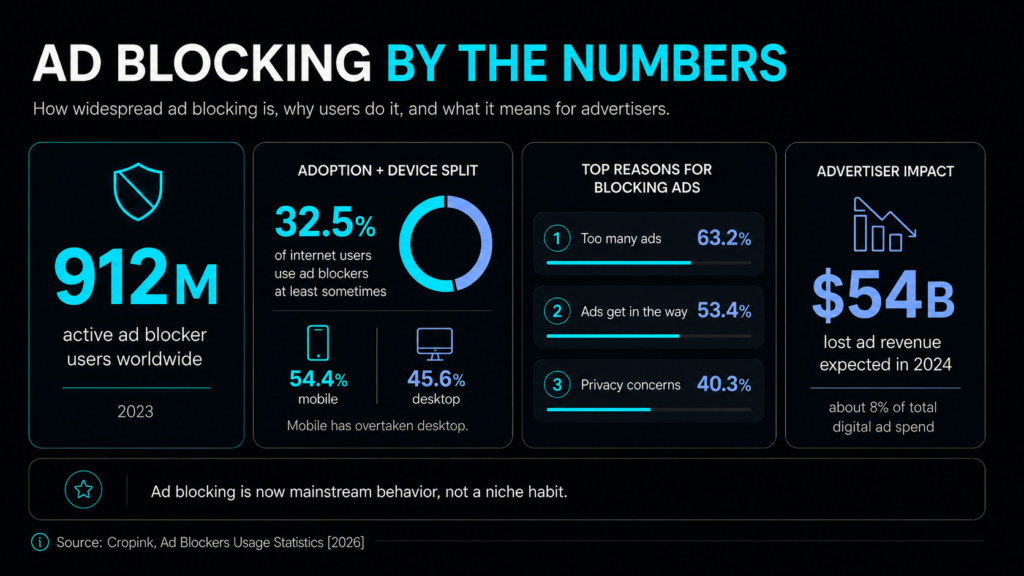
This is where dashboards mislead. A blocked pre-roll does not always register as a failed impression at a glance. The report can look healthy while a meaningful share of the paid audience never rendered the creative. If a brand measures only delivered impressions, it never sees the gap between what it bought and what reached a screen. Understanding how ad blockers work explains why this slips past standard reporting.
There is a second cost. A pre-roll interrupts the stream, which is the opposite of why the viewer showed up. When that registers as irritation, it attaches to the brand that caused it. For a non-endemic brand trying to earn a place in gaming culture, a poorly placed interruption can do more damage than no campaign at all.
What contextual live stream advertising does differently
Contextual advertising changes the delivery mechanism, and the mechanism is the point.
A standard display or pre-roll ad is fetched from an external ad server, which is exactly what a blocker watches for and stops. Contextual content works the other way around. The brand element is delivered as part of the stream itself, so there is no separate external call to intercept. Nothing about the network request looks like an ad, because structurally it is not served like one.
The trigger is what makes it relevant instead of intrusive. A branded element can appear when a streamer says a specific phrase, when viewers type a pattern in chat, or when something happens in the game. The brand shows up because the moment called for it, not because a timer ran out. 79% of Twitch viewers see in-stream brand integrations as support for the creator rather than as advertising.
What brands have achieved with contextual Twitch advertising
The results gap between interruptive and contextual formats is not marginal.
T-Mobile built a campaign around a single phrase, “The Fastest Network,” triggered by natural streamer speech. The phrase was spoken organically over 10,000 times, drove 800,000 views, and lifted brand affinity by 16 percentage points and recall by 11. The brand earned the mentions because the trigger fit the moment.
Knorr ran a contextual voice-triggered campaign in Romania and recorded a +52 percentage point lift in ad recall and a +45 point lift in top-of-mind awareness, among the highest brand lift figures recorded for a non-endemic brand on the platform.
Put those next to standard digital benchmarks. Meta’s published median recall lift runs between 4 and 8 percentage points for normal campaigns, and YouTube’s sits around 5. A contextual gaming campaign clearing 50 points is operating in a different range.
Which Twitch format fits your campaign?
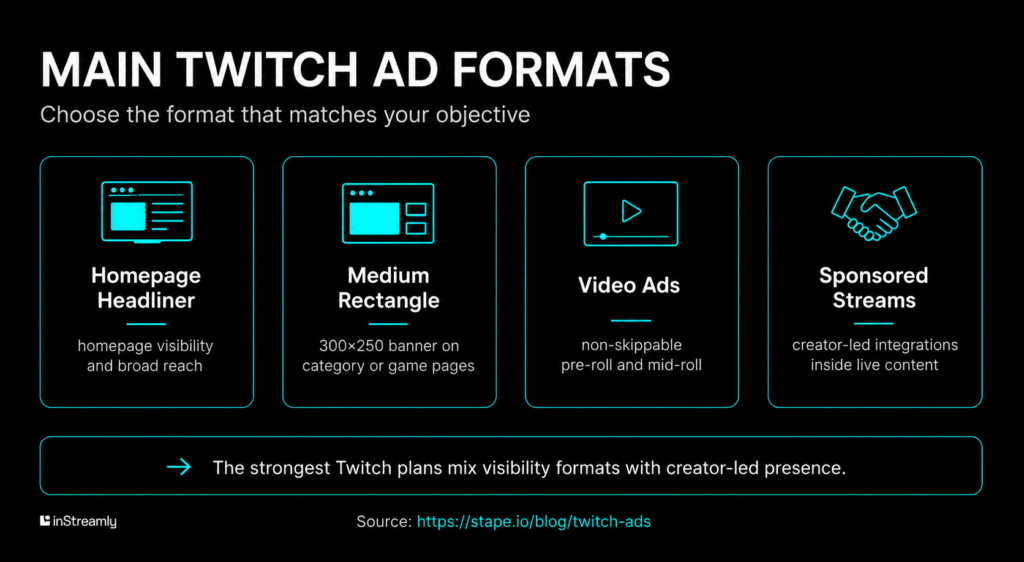
No single format wins every objective. Standard programmatic ads make sense when the goal is broad, measurable reach and impression volume matters more than engagement depth. Contextual and native formats make sense when the objective is brand recall, affinity, or reaching the ad-blocked majority that standard formats miss. Direct creator sponsorships make sense when the campaign depends on authentic product demonstration or deep community integration with a specific creator.
A short planning checklist:
- Define the primary KPI first. Reach and frequency point toward programmatic. Recall and affinity point toward contextual.
- Estimate how much of your target audience blocks ads before committing budget to formats blockers catch.
- Match measurement to format. Use delivered impressions for reach, and brand lift studies for recall and affinity.
The takeaways
- Twitch’s four standard formats are bought programmatically at a CPM of roughly $2 to $10, rising to $8 to $12 in Q4, and they reach the audience least likely to let an ad render.
- Around 64% of gamers block ads, so a campaign built only on standard formats pays for impressions a large share of the target never sees while the dashboard still looks healthy.
- Contextual formats bypass blockers structurally and are read as creator support by 79% of viewers, which is why T-Mobile and Knorr post brand lift figures standard digital formats do not approach. Choose by objective: programmatic for reach, contextual for recall and affinity, direct deals for community depth.