For BrandsMarketing09.07.2026

What Is Top-of-Mind Awareness, and Why It’s the Most Competitive Brand Metric
Ask a media buyer to list every ad they saw yesterday and most will stall after the third one. Ask them which brand comes to mind first when they think of energy drinks, streaming platforms, or telecom providers, and the answer arrives instantly, with no list to search through. That instant, unprompted answer is top-of-mind awareness, and it is the most valuable position a brand can hold in a competitive category.
Most brand tracking still treats awareness as a single number. It isn’t. A consumer can recognize a logo, recall a name when prompted, and still name a competitor first when nobody prompts them at all. That first name is the one that gets shortlisted, considered, and usually bought. This article covers what top-of-mind awareness actually measures, how brand teams track it, and what moved the number by 45 percentage points in a single live streaming campaign, a result that sits far outside typical benchmarks.
What is top-of-mind awareness?
Top-of-mind awareness (TOMA) is the brand a consumer names first when asked an unprompted question about a category:
- Not the brand they recognize when shown a logo
- Not a brand they can eventually recall if given time
- The first one, with no cue at all
This makes TOMA the sharpest form of a broader concept called unaided brand recall. Aided awareness, the weakest of the three, only requires a consumer to recognize a brand once it’s shown to them. Unaided recall requires the consumer to produce a brand name from memory, with no prompt other than the category. Top-of-mind awareness sets a higher bar again: out of everything the consumer could name unprompted, which one came first.
That distinction matters commercially because purchase decisions rarely start with a full list of options. Most people work from a mental shortlist of two or three brands, and the brand named first tends to make that shortlist automatically. Being remembered eventually is useful. Being remembered first changes which brands get compared at all.
How is top-of-mind awareness measured?
TOMA is measured through an open-ended, unaided survey question, typically some version of: “When you think of [category], what brand comes to mind first?” No logos, no brand lists, no hints. The question has to come before any other brand-specific question in the survey, because once a respondent sees a competitor’s name or logo, the unaided measurement is compromised.
A few practical rules govern how this gets run well:
- Sample the full category audience, not just existing customers, or the result measures loyalty rather than category-wide mindshare.
- Use a large enough sample. Consumer categories generally need north of a thousand respondents per wave to detect real movement. Smaller samples introduce noise that looks like a shift but isn’t.
- Ask the TOMA question first, before any other brand question, to avoid contaminating the unaided measurement.
- Track it on a recurring cadence, monthly or quarterly. TOMA moves slowly, and a single reading tells a brand team very little.
The output is usually expressed as share of mind: the percentage of respondents who named a given brand first, benchmarked against how often competitors got named first in the same wave. Alongside the formal survey, teams often watch supporting signals that move in the same direction:
- Branded search volume trends
- Organic brand mention frequency
- Word-of-mouth signals picked up through social listening
Frequency and context build top-of-mind awareness, not exposure alone
Simply showing up often does not build top-of-mind awareness. Showing up often in a context the audience already cares about does. The distinction sounds small, but it’s the difference between a campaign that gets ignored at scale and one that actually gets encoded into memory.
Memory encoding responds to relevance, emotional association, and moments of genuine attention, not raw frequency. A pre-roll ad running a hundred times in front of a distracted viewer builds less first-mention recall than a single well-timed brand appearance that lands while the viewer is actually paying attention to something related.
This is where live streaming’s contextual mechanism produces results that standard media rarely reaches. Knorr’s Romanian campaign built through inStreamly triggered branded animations when streamers said keywords related to gaming energy and hunger, timing the brand’s appearance to the exact moment the topic was already on a viewer’s mind. Top-of-mind awareness for Knorr moved from 27% to 72%, a 45 percentage point lift, among a category where non-endemic FMCG brands rarely register at all. The mechanism was not more impressions. It was better-timed ones.
Top-of-mind awareness sits above unaided recall and aided awareness
These three terms get used interchangeably in briefs, and that’s a mistake worth correcting before a campaign gets planned around the wrong one.
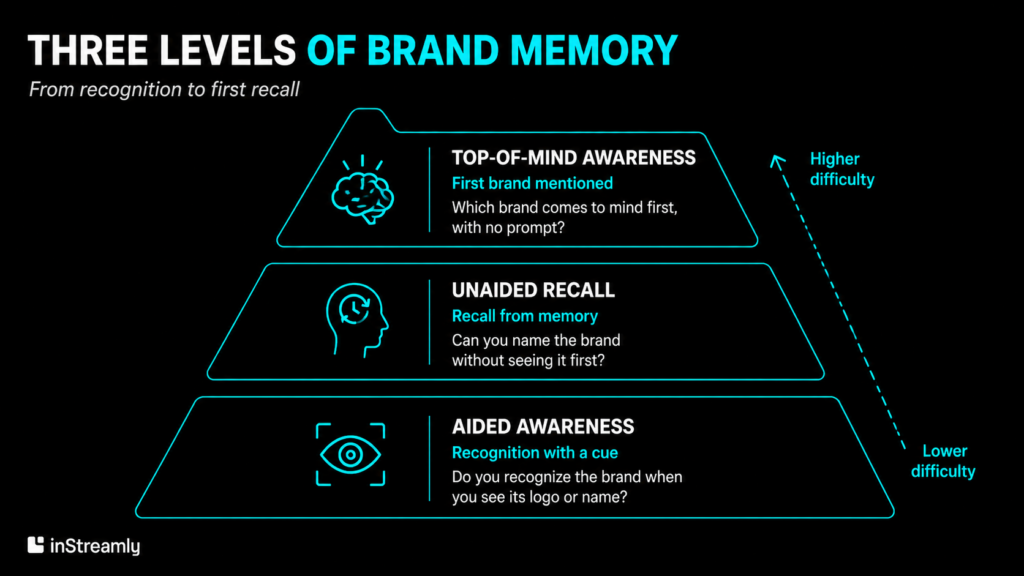
- Aided awareness (the floor). A consumer sees a brand name or logo and confirms they’ve heard of it. It requires recognition, not memory retrieval, and it is the easiest score to move and the least commercially meaningful on its own.
- Unaided recall (the middle tier). The consumer names brands from a category with no prompt at all, and any brand they mention, in any order, counts. This is a genuine test of memory, and it tells a brand team whether it’s in the consideration set.
- Top-of-mind awareness (the ceiling). Out of everything a consumer could name, which one did they say first. It is the only one of the three metrics that produces a single winner per respondent, which is why share of mind data reads cleanly across waves and competitors in a way aided or unaided numbers don’t.
The strategic mistake most brand teams make is investing heavily in aided awareness, which is the cheapest metric to move and the one that flatters a media plan, while underinvesting in the harder, slower work of building first-mention frequency. A brand can post strong aided awareness numbers and still lose every purchase decision to a competitor who gets named first.
How do brands actually build top-of-mind awareness?
Three things tend to show up together in brands that win the first-mention position:
- Reach delivered in genuinely relevant contexts, not just high volume
- Distinctive brand assets that encode faster than generic creative
- Repetition inside a community, until the brand becomes part of how that community talks
The clearest recent example of the third driver is T-Mobile’s Fastest Network campaign, run through inStreamly’s voice recognition mechanism. The phrase “the fastest network” was triggered automatically whenever a streamer said it on air, and streamers ended up saying it organically more than 10,000 times over the course of the campaign, without being paid per mention. The phrase became something gaming audiences said naturally, not something a script forced. That’s community embedding: a brand doesn’t just get seen often, it gets absorbed into a shared vocabulary, and vocabulary is exactly what surfaces first when someone is asked to name a brand with no prompt.
Distinctive brand assets, a sonic cue, a visual code, a repeated phrase, matter here because they encode faster than a generic message. A consumer doesn’t need to reconstruct an argument to recall a phrase they’ve heard a hundred times in a context they enjoy. The phrase is already sitting in memory, ready to surface first.
This is also why TOMA campaigns depend on genuine attention rather than raw reach. A brand appearance a viewer skips past or mutes contributes nothing to memory, no matter how many times it runs. The attention a live stream audience actually gives a brand is a large part of why contextual formats outperform passive ones on this specific metric.
Most brand lift campaigns move top-of-mind awareness in single digits
Setting expectations correctly matters more for TOMA than for almost any other brand metric, because the typical range and the outlier range are wildly different, and a brand team that doesn’t know the difference will either celebrate a mediocre result or dismiss a genuinely strong plan too early.
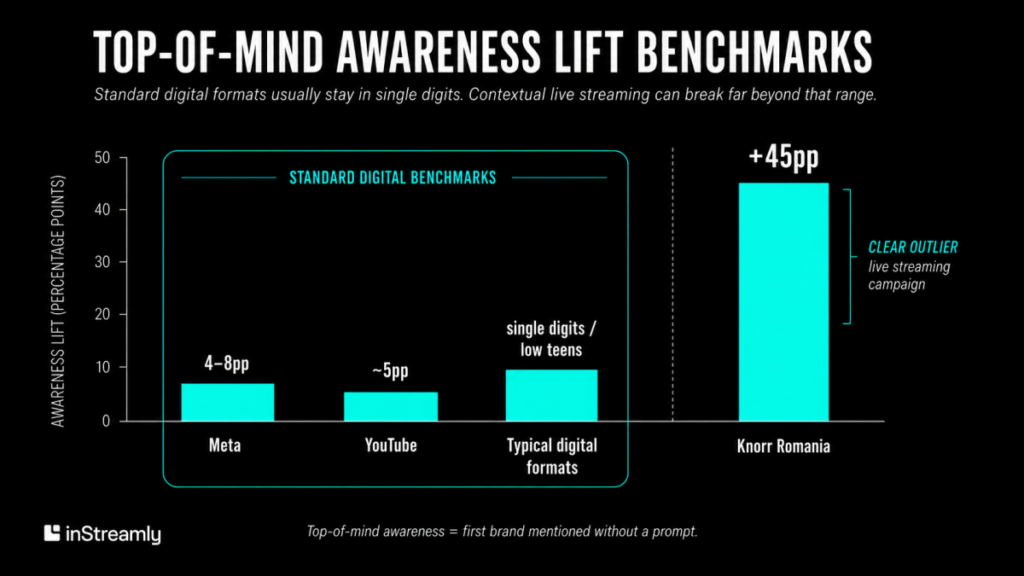
Typical top-of-mind lift by format:
- Meta campaigns: median recall lift of 4 to 8 percentage points
- YouTube campaigns: around 5 percentage points
- Standard digital formats overall: single digits, occasionally low teens for an unusually strong creative and media plan
- Contextual live streaming (Knorr, Romania): +45 percentage points, an outlier result even within inStreamly’s own portfolio
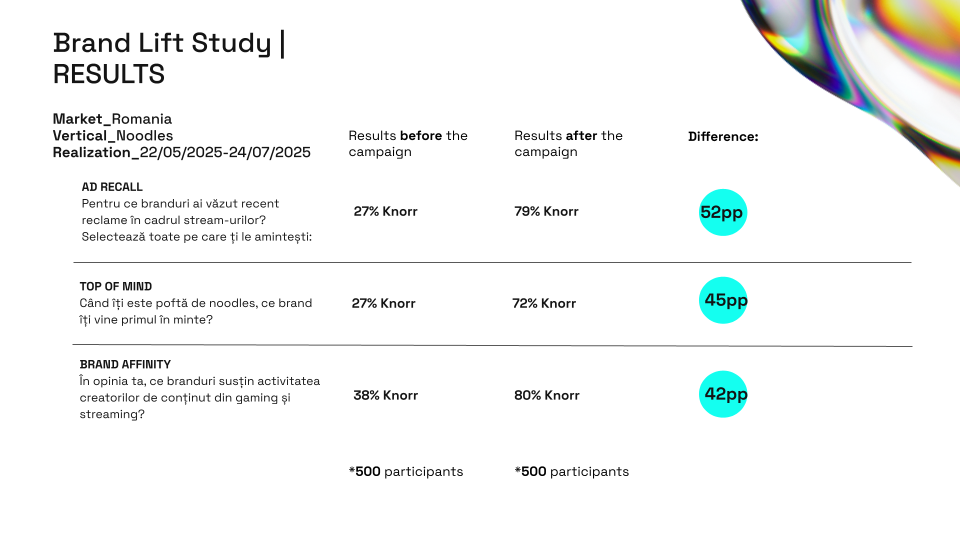
Contextual live streaming campaigns operate in a different range entirely when the mechanism is right. Knorr’s lift illustrates the ceiling that contextual, moment-matched advertising can reach when a brand’s appearance is tied to something the audience already cares about at that exact second.
Before planning a TOMA-focused campaign, a few questions are worth settling upfront:
- What is the current share of mind for the brand and its top two or three competitors in this category, measured through the same unaided question?
- Is the objective genuinely first-mention movement, or would a cheaper aided-awareness or consideration campaign serve the actual business goal better?
- What is the realistic timeline for measurement? A single reading proves nothing. Plan for at least two waves, pre and post, ideally with a matched control group that wasn’t exposed to the campaign.
- Does the category and brand maturity justify a TOMA push right now, or is the brand still building basic unaided recall first?
TOMA is worth prioritizing when a brand already has reasonable unaided recall and is fighting for the position of first mention against two or three named competitors. It’s the wrong metric to chase for a brand still working to get onto the shortlist at all.
Key takeaways
- Top-of-mind awareness measures which brand a consumer names first with no prompt, making it the sharpest and most competitive form of brand recall.
- It’s measured through an unaided survey question asked before any other brand question, tracked on a recurring wave across a representative category sample.
- Frequency alone doesn’t build TOMA. Frequency in a genuinely relevant context does, which is why Knorr’s contextually triggered campaign produced a 45 percentage point lift against a typical single-digit benchmark.
- TOMA sits above aided awareness and unaided recall in the measurement hierarchy, and brand teams often overinvest in the easier, lower metrics while underinvesting in first-mention frequency.
- Community embedding, brand language that audiences repeat unprompted, builds TOMA more durably than paid frequency alone, as shown by T-Mobile’s organically repeated tagline.