![Which Live Streaming Platform Pays The Most? [2026]](https://wordpress-instreamly.s3.eu-west-2.amazonaws.com/wp-content/uploads/2023/01/13102041/medium-shot-gamer-playing-computer-2-1.jpg)
Which Live Streaming Platform Pays The Most? [2026]

Twitch.tv
YouTube Gaming
Kick.com
Huya.com
What about Trovo?
Twitch.tv
It’s probably not surprising that Twitch is the first platform we want to look at. It is still one of the most recognizable live streaming platforms in gaming and remains the default choice for many creators starting out. Twitch has many loyal fans, however, many voices criticise their approach to streamers. First, let’s discuss your options if you want to make money directly through the platform.
Affiliate Program
Income options as a Twitch Affiliate or Partner
- Subscriptions
- Bits (fan donations)
- Ads
Twitch pros
- It is the most recognizable live streaming platform for gaming audiences
- It is relatively easy to explain and promote your Twitch channel across other social platforms
- Twitch-native monetization becomes straightforward once you reach Affiliate
- The subscription model is simple and works well for long-term community building
- There are many websites where you can check Twitch stats and channel performance
- It has a very distinct culture, including its own slang, emotes, and chat behavior
- You can use inStreamly while streaming on Twitch to earn extra money
- It remains one of the strongest platforms for live-first community interaction
Twitch cons
- The default revenue split is still not very creator-friendly compared to some newer platforms
- Discoverability is still one of Twitch’s weaker points
- Fast-moving chats can become difficult to moderate as a channel grows
- Native monetization options are limited before you reach Affiliate
- Twitch’s moderation and enforcement decisions are sometimes criticized by creators
- Twitch restricts promotion of certain gambling-related sites and content
YouTube Gaming
YouTube Partner Program
To unlock ad revenue and YouTube Premium revenue sharing, you still need the higher threshold: 1,000 subscribers and either 4,000 valid public watch hours in the last 12 months or 10 million valid public Shorts views in the last 90 days.This means YouTube is more accessible than it used to be, especially for creators who combine livestreams with regular video content.
Income options as a YouTube Partner
As a Partner, you get paid for your content with the help of:
- Ads & YouTube Premium
- Super Chat & Super Stickers
- Memberships
- YouTube Shopping & BrandConnect
- Super Thanks
This is where YouTube becomes very interesting. The platform does not rely on one monetization model only. Instead, it gives creators a mix of ad revenue, fan funding, and commerce tools.
One important detail is that YouTube’s splits depend on the feature. For fan funding tools like channel memberships, Super Chat, Super Stickers, and Super Thanks, creators receive 70% of net revenue after taxes and fees. That makes these features attractive for creators with loyal communities.
YouTube also pays creators from YouTube Premium watch time, which means viewers can support your content even when they are not seeing ads.
And unlike older versions of the Partner Program, monetization tools like memberships and fan funding are no longer locked behind an extremely high subscriber count. That makes YouTube much more realistic for smaller creators than it used to be.
YouTube Gaming Pros
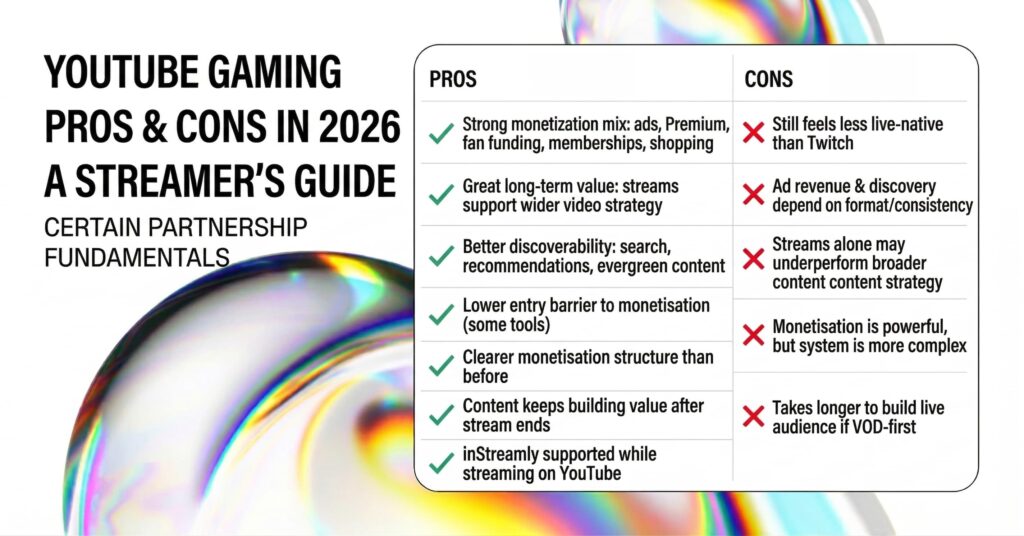
- Strong monetization mix: ads, YouTube Premium, fan funding, memberships, and shopping
- Great long-term value because livestreams can support your wider video strategy
- Better discoverability through search, recommendations, and evergreen content
- Lower entry barrier to some monetization tools than before
- Clearer monetization structure than older versions of the program
- You can keep building value from content after the stream ends
- You can use inStreamly while streaming on YouTube
YouTube Gaming cons
- It still feels less live-native than Twitch
- Ad revenue and discovery depend heavily on content format and consistency
- Live streams alone may not perform as well as a broader YouTube content strategy
- Monetization is powerful, but the system is more complex than Twitch’s
- It may take longer to build a loyal live audience if your channel started as VOD-first
Kick.com
This is one of the newest streaming platforms, so don’t feel bad if you’ve never heard about it. The launch was announced in 2022 by a former Twitch streamer, Tyler “Trainwreckstv“. Kick hopes to overthrow Twitch by introducing enticing policies and programs. The platform is still beta-testing, so no details about the future models are known, but here is what we know.
Kick policies
- 95/5 subscription revenue split
- Creator status and subscription access can be unlocked after 5 streamed hours
- Strong creator-first positioning
- Multistreaming-friendly ecosystem
- Clear monetization-focused branding
This is the biggest reason why many streamers ask whether Kick pays the most. On paper, a 95/5 subscription split is far more generous than Twitch’s default split and more aggressive than what most creators think of when comparing traditional platforms.
Still, money split is not everything. Kick is attractive because it lowers the barrier to monetization, but creators should also think about audience size, platform culture, long-term discoverability, and how stable the ecosystem feels compared to Twitch or YouTube.
In other words: if you are looking at raw subscription split alone, Kick is extremely hard to beat. If you are thinking about the full creator business, the answer becomes more complicated.
Huya.com
Huya.com is an excellent platform if you are Chinese or know Mandarin! Otherwise, you will have little fun there.
Huya still operates and remains a major game live streaming platform in China. That said, it is much more region-specific than Twitch, YouTube, or Kick, so for most English-speaking creators it is not the most practical platform to compare directly. It is still worth knowing about, especially if your audience is in China or you are interested in the Asian live streaming market.

What about Trovo?
Summary
So which streaming platform pays the most in 2026? The shortest answer is: it depends on what kind of income you mean.
If you are looking mainly at raw subscription split, Kick is the most generous of the three. If you are thinking long-term and want to combine livestreams with ads, memberships, fan funding, search discovery, and evergreen content, YouTube may offer the most complete monetization system. And if your priority is live-first culture, recognizable streaming identity, and a platform built around community interaction, Twitch still remains one of the strongest choices — even if it is not always the most creator-friendly by default.
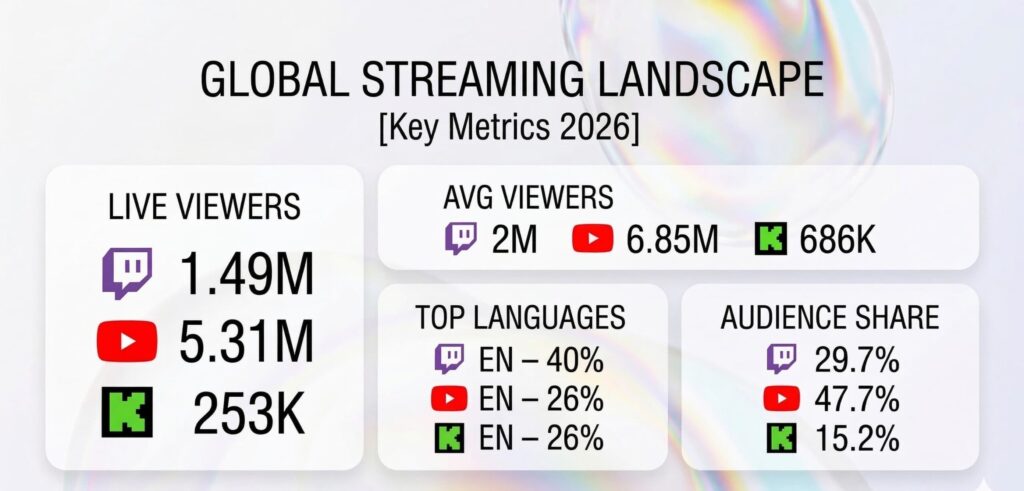
March 2026 data based on StreamCharts
Do you have any thoughts on the subject? Be sure to share them with us on our Discord server (and in the future comments section we are working on)!