
FOMO Marketing: How Brands Use Fear of Missing Out to Drive Conversions
In markets saturated with offers, attention is scarce and hesitation is expensive. One of the most reliable psychological accelerators in digital commerce is FOMO—Fear of Missing Out. It works because it reframes a decision from “Should I buy?” into “What do I lose if I wait?”, which naturally increases urgency and reduces delay.
This article explains how FOMO influences consumer decisions and how brands use scarcity, urgency, and exclusivity to increase engagement and sales without damaging trust.
What Is FOMO and Why Does It Matter in Marketing?
FOMO is a psychological response tied to social comparison and perceived exclusion. It is anxiety driven by the idea that others might be having rewarding experiences without you, which can push people toward quicker decisions when a perceived opportunity looks limited or popular.
In marketing contexts, FOMO shows up most strongly when consumers feel they might miss a benefit that others will get first: a deal, access, inventory, or status. It’s particularly effective in social environments where purchase cues are visible, such as marketplaces, travel, and creator-driven commerce.
What Is FOMO Marketing?
FOMO marketing is the structured use of cues that signal limited availability, social momentum, or restricted access. The goal is not to add pressure for its own sake, but to reduce uncertainty and indecision by making the context of the decision clearer: what’s available, for how long, and how others are behaving.
Most FOMO tactics fall into three categories:
- Scarcity (limited supply)
- Urgency (limited time)
- Exclusivity (limited access)
When those cues are credible and aligned with real value, they can increase conversion without harming long-term perception.
The Three Core FOMO Triggers Brands Use
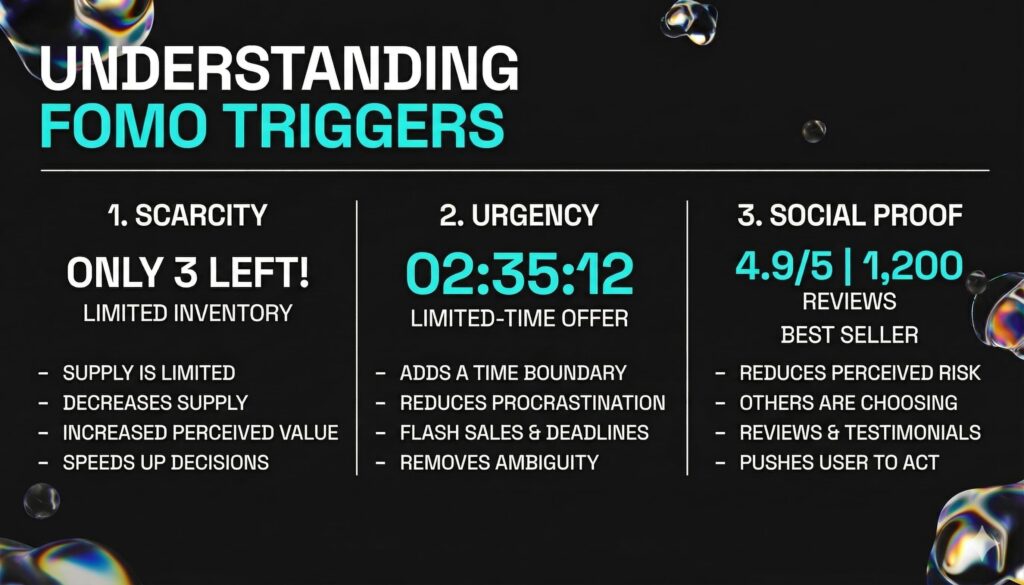
1) Scarcity
Scarcity signals that supply is limited, which increases perceived value and speeds up decisions. In practice, scarcity works best when it reflects real constraints, such as limited inventory, capacity, or time-sensitive availability (e.g., hotel rooms, event seats).
Common applications include low-stock labels, “only X left” messaging, and capacity indicators.
2) Urgency
Urgency adds a time boundary to a decision. This is typically implemented via flash sales, limited-time offers, or deadline-based messaging. Countdown timers are popular because they make time visible and reduce procrastination.
Used well, urgency removes ambiguity (“how long is this available?”). Used poorly (fake deadlines), it undermines trust.
3) Social proof
Social proof reduces perceived risk by showing that others are choosing the same option. This can include star ratings, review counts, “best seller” badges, live purchase notifications, or “X people are viewing this” indicators.
Trustmary highlights the role of reviews, testimonials, and visible activity as cues that others are benefiting from the offer, which can push undecided users to act rather than delay.
Practical FOMO Tactics Marketers Actually Use
Stock levels and “selling fast” messaging
These cues convert abstract scarcity into something concrete. They are especially common in travel and ticketing, where availability truly changes in real time.
Countdown timers and deadline framing
Timers work when they reflect an actual end date for pricing, bundles, or access. They are also effective in lifecycle messaging (e.g., cart abandonment reminders) because they provide a clear reason to decide now rather than later.
Best-selling and top-rated product surfacing
Highlighting popular items simplifies choice and reduces evaluation effort. It also adds social validation without needing aggressive copy.
Early access, VIP drops, and limited editions
Exclusivity creates differentiation through access rather than discounting. It tends to be most effective when paired with a clear “why” (members get early access because they are loyal, subscribers get first access because they opted in, etc.).
Gated or expiring content
FOMO is not only for products. Limited access to content (resources, templates, invite-only webinars) can increase opt-ins when the value is clear and the trade-off is transparent.
“Missed opportunity” framing
Showing that an option is sold out or that a deal has ended can increase urgency on the next decision. It often works best when paired with alternatives, so the user has a path forward rather than just friction.
When FOMO Backfires and How to Keep It Ethical
FOMO tactics are sensitive because they influence decisions quickly. If the cues are misleading, consumers often notice—and the cost is trust.
A practical ethical checklist:
- Scarcity must be real (inventory and capacity indicators should reflect reality).
- Deadlines must be true (no rolling “ends tonight” timers).
- Social proof must be accurate (no fabricated purchase notifications or inflated counts).
- Value must stand on its own (FOMO should accelerate a good decision, not compensate for weak product-market fit).
FOMO can build excitement without misleading users, but only when it’s used sparingly, paired with genuine value, and designed to protect the customer experience.
Final Thoughts
FOMO marketing works because it addresses a common friction point in buying journeys: hesitation. Scarcity, urgency, and exclusivity are not magic tricks; they are decision context signals. When those signals are truthful and aligned with real value, they can reduce uncertainty and accelerate action.
For marketers, the strategic question isn’t “should we use FOMO,” but “where does FOMO reduce decision friction without compromising trust.” That answer will usually be found at high-intent moments: product pages, checkout flows, booking steps, cart recovery, and launches.
Sources
- Trustmary — 7 Real Examples You Can Copy of Using Fear of Missing Out (FOMO) in Advertising
![Which Live Streaming Platform Pays The Most? [2026]](https://wordpress-instreamly.s3.eu-west-2.amazonaws.com/wp-content/uploads/2023/01/13102041/medium-shot-gamer-playing-computer-2-1.jpg)