For BrandsMarketing09.06.2026

What is ad recall and how do you measure it?
Every digital campaign produces impressions. Most of them produce nothing else. A brand can run a display campaign across a hundred placements, hit the reach target exactly, and still find that almost nobody who saw the ads can name the brand a day later. Ad recall is the metric that exposes this gap. It tells you not whether an ad was served, but whether a person actually registered it.
Ad recall rates have been declining across standard digital formats. The environment is more saturated, audiences have trained themselves to ignore patterns they recognise as advertising, and pre-roll continues to run before anyone asked to see it. At the same time, live streaming consistently returns brand memory scores that most digital channels have stopped producing. This article covers what ad recall is, how it is measured, what benchmarks to use, and why gaming audiences score it higher than almost any other channel.
What is ad recall?
Ad recall is the percentage of people who remember seeing an advertisement after exposure. It is measured by comparing two groups: people who were exposed to the ad and a holdout group who were not. The difference between those two groups is the ad recall lift – the number that tells you how much memory the campaign actually built, not just how many impressions it served.
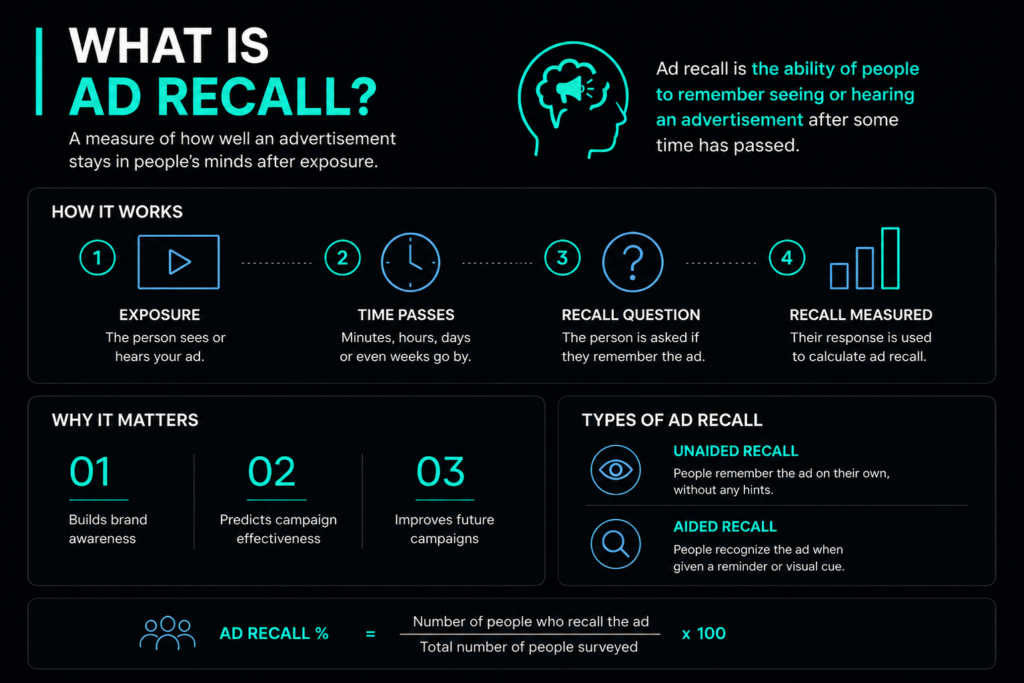
There are two variants. Aided recall asks respondents whether they remember a specific ad after being shown it. Unaided recall asks them to name brands from a category without any prompt. Unaided is the harder test and the more commercially relevant one. It reflects the kind of memory that surfaces when a consumer is standing in front of a shelf or opening an app to make a purchase – not when a researcher is pointing them at an asset and asking if they recognise it.
Ad recall sits between impressions and purchase intent in the measurement hierarchy. Impressions tell you the ad was delivered. Purchase intent tells you it influenced behaviour. Ad recall tells you the one thing most digital metrics skip: did the message land?
How is ad recall different from brand recall and brand awareness?
These three terms are related but measure different things, and conflating them leads to misreading campaign performance.
Brand awareness measures whether an audience knows a brand exists. Brand recall measures whether they can retrieve it from memory when prompted by a category. Ad recall measures whether they remember seeing a specific advertisement.
All three sit at the awareness stage of the funnel, but they answer different questions. A brand with high awareness can still produce poor ad recall if its ads are forgettable. A campaign with strong ad recall can exist in a market where overall brand awareness is low. For non-endemic brands entering a new channel – like a financial services company running its first gaming campaign – ad recall is often the most honest first test. Did anyone in this audience even register that the brand was there?
How do you measure ad recall?
The standard method is a brand lift study. A survey runs with two groups: people exposed to the ad and a holdout group that was not. The recall lift is the gap between them.
Ad recall survey design varies by objective. Aided recall surveys show respondents a creative asset and ask whether they remember seeing it. Unaided surveys ask for category recall without any cue – which brands in this category can you name? The two approaches answer different questions and should not be treated as interchangeable.
Timing matters. Post-exposure surveys run 24 to 72 hours after exposure measure short-term memory encoding. Longer windows test retention. Running a survey too soon after a campaign can inflate results; running it too late can understate them.
Who runs these studies: Happydemics, Nielsen, and Kantar all offer brand lift measurement as a service. For campaigns running through inStreamly, brand lift measurement is built into campaign reporting, so there is no need to run a separate study.
One practical note for media buyers: set a recall lift target before the campaign, not after. A result of “+20 percentage points” means nothing without a baseline and a benchmark. Without context, a number is just a number.
What counts as a good ad recall benchmark?
Ad recall rates across standard digital formats have declined roughly 5 percentage points since 2023, driven by ad saturation and increasingly well-trained audience avoidance. Average display lift typically falls in the 2 to 5 percentage point range. Pre-roll video performs better but has been declining as viewers learn to look away before the skip button appears.
Contextual and native formats outperform both. The structural reason is straightforward: an ad that matches the content the viewer is already engaged with does not have to overcome cognitive resistance before it communicates anything.
Benchmarks also shift by format, category, and audience familiarity. A “+10pp” result for a non-endemic brand entering gaming for the first time may be a strong outcome. The same number for a well-known brand in a familiar context may signal underperformance. The right benchmark is a comparable campaign, in a comparable context, for a comparable audience.
Why ad recall in live streaming outperforms standard digital
Live streaming creates a structural advantage for brand memory that does not depend on creative quality alone.
The attention state is different. Viewers are in an extended, voluntary session. The average live viewing session runs 25.4 minutes – significantly longer than on-demand video. That extended engagement means more time for a brand message to be encoded, not just seen.
The interaction layer deepens it further. Twitch users send over 29 billion chat messages during live streams. Active participation – typing, reacting, following the streamer’s commentary – is not passive consumption. Cognitive engagement at that level improves memory encoding. A viewer who typed a response to something a streamer said about a brand is more likely to remember the brand than one who watched a pre-roll while waiting for content to start.
The trust dynamic is also structurally different. A streamer is not a media channel – they are a person the audience has chosen to spend time with. Nielsen research on podcast advertising found that host-read ads produce a brand recall rate of 71%, because the recommendation comes from a trusted voice rather than an anonymous ad unit. The same principle applies when a streamer mentions a brand organically during a live session.
Contextual timing amplifies this further. Research found contextually targeted ads score 29% higher on ad recall than cookie-based alternatives. A separate study found that viewers pay nearly 4x more attention to contextually targeted CTV ads than to demographically targeted ones. In a live stream, contextual timing means the brand appears at the exact moment it is relevant to what the streamer is doing or saying – not inserted between content segments on a schedule.
What inStreamly campaign data shows about ad recall in live streaming
Three campaigns illustrate what these structural advantages produce in practice.
The Knorr Romania VRM campaign produced a +52 percentage point ad recall lift and +45pp top of mind. These are among the highest brand lift results recorded for a non-endemic FMCG brand in a streaming context. The mechanism: branded animations triggered by contextually relevant keywords spoken during the stream, so the brand appeared at the exact moment it was most relevant to the viewer.

T-Mobile’s “The Fastest Network” campaign produced +11pp brand recall and +16pp brand affinity through over 10,000 organic streamer mentions. The phrase was spoken by streamers naturally, triggered by Voice Recognition Mechanism — not scripted, not inserted as a pre-roll. It became the most-said phrase in gaming streams that quarter.
The Dr. Oetker Guseppe campaign delivered +33pp ad recall with 1,896 personalized creatives — one built for each individual streamer. The personalization meant each integration felt native to that streamer’s channel rather than generic.
The common thread across all three: the brand appeared at a moment contextually relevant to what was happening on stream. Not as an interruption. Not before the content started.
When ad recall is – and isn’t – the right metric
Ad recall is the right metric for brand awareness-stage objectives. It tells you whether memory was built. For direct-response objectives, it is one signal among several – pairing it with branded search lift or consideration surveys gives a fuller picture of whether intent moved, not just memory.
For non-endemic brands entering gaming for the first time, ad recall works well as a proof-of-concept metric. It answers the foundational question: did this audience register the brand at all?
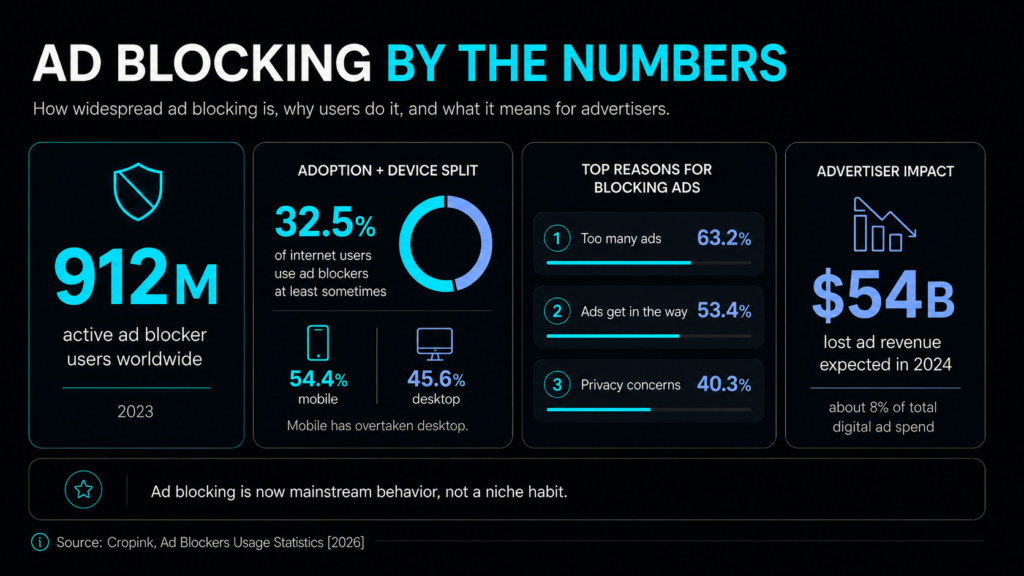
One structural point worth noting for media planning: a significant share of the gaming audience is unreachable through standard display formats altogether. Around 40% of online gamers regularly use ad blockers, blocking standard display and pre-roll before it reaches them. Contextual in-stream advertising reaches this audience because it is delivered as part of the stream itself, not from an external ad server. For brands looking to understand why ad blocker adoption matters for campaign reach, the implications go beyond gaming.
Key takeaways
- Ad recall measures whether memory was built, not whether an impression was served. It is the metric that sits between delivery and intent.
- Aided and unaided recall are different tests and should not be used interchangeably. Unaided recall is the stronger commercial signal.
- Set a recall lift target before the campaign runs. Without a baseline and benchmark, the result has no context.
- Live streaming produces structurally higher ad recall because of session length, active audience engagement, streamer trust, and contextual timing — not because of creative quality alone.
- Campaign results from non-endemic brands in live streaming consistently show recall lifts in the +11pp to +52pp range, well above standard digital benchmarks.