For BrandsMarketing14.07.2026

Advertising Effectiveness: The Metrics That Show Whether Your Campaign Actually Worked
A report showing 4 million impressions and a 0.4% click-through rate looks like a result until someone asks whether the target audience remembers the brand a week later. Most advertising effectiveness reporting stops at the numbers that are easiest to pull from a dashboard: impressions, clicks, view rate. None of these confirm that exposure changed what people think, remember, or intend to buy.
That gap matters even more for gaming and live streaming audiences. Standard attribution models are built around clicks, and most brand content inside a stream is not clickable. A large share of the reach reported for standard display never lands at all: ad blocker adoption among gaming audiences means a meaningful portion of served impressions are invisible before effectiveness even enters the conversation. Media buyers who apply display-style reporting to a streaming campaign end up measuring the wrong layer entirely, then conclude the channel underperformed when the channel simply was not built to be judged that way.
This article breaks down the full advertising effectiveness measurement stack, shows where each metric applies, and explains what to measure differently when the campaign runs inside live streaming content.
The gap between what advertisers track and what effectiveness actually requires
Three numbers dominate most campaign reports, and none of them measure effectiveness on their own.
- Impressions count how many times an ad was served. They say nothing about whether anyone looked at it.
- Click-through rate measures interaction with the ad unit. For brand campaigns with no purchase intent yet, a click is often just curiosity, not consideration.
- View rate confirms technical delivery: the video played. It does not confirm that a person registered the brand behind it.
Advertising effectiveness asks a different question: did this exposure change something in the viewer’s head or their next purchase decision? Answering that requires metrics built to measure perception and behavior, not delivery.
What does a complete advertising effectiveness measurement stack look like?
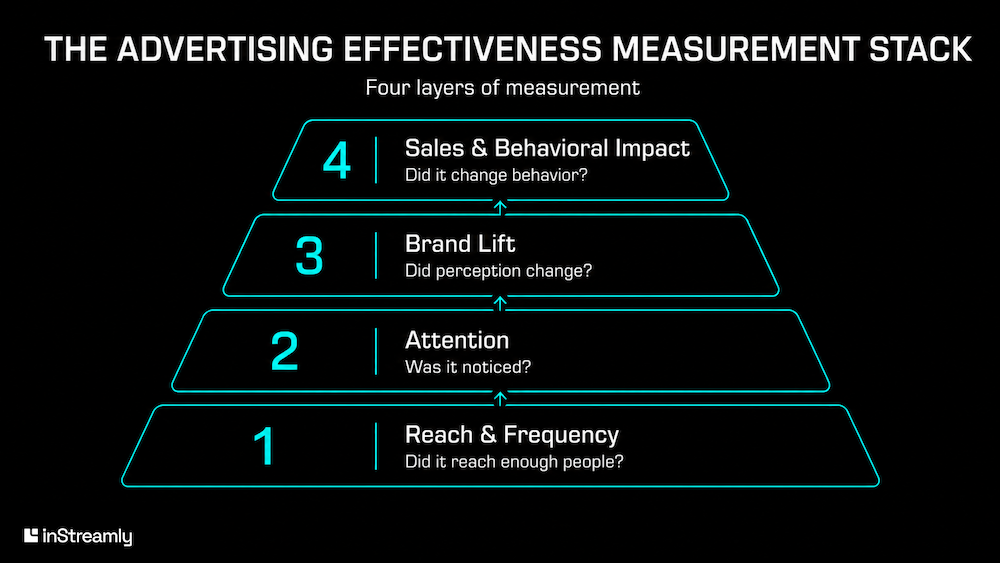
A full stack has four layers, and each one answers a question the others cannot.
- Reach and frequency. Did the campaign reach the intended audience, and how many times? This is the foundation. Without it, nothing above it means anything.
- Attention. Was the ad actually seen, and for how long? This is the layer most media plans skip entirely.
- Brand lift. Did awareness, recall, consideration, or affinity move after exposure, compared to a group that was not exposed?
- Sales and behavioral impact. Did the campaign produce measurable purchase intent, search activity, or sales?
Each layer isolates a different variable. A campaign can achieve excellent reach and still fail on attention. It can earn strong attention and still fail to shift brand recall if the creative carries no message. Reporting on only one layer, usually reach or clicks, produces a picture that looks complete but tells you almost nothing about whether the money worked.
Why attention is the layer most reporting still skips
Viewability is not attention. The IAB and MRC define a viewable display impression as one where 50% of the ad’s pixels sit in view for one continuous second, two seconds for video. That threshold confirms an ad had the chance to be seen. It says nothing about whether a person actually looked at it.
A 2025 study run with Snapchat, WPP Media, and Lumen Research found that measured attention predicts brand recall roughly eight times better than view-through rate, and predicts brand favorability about four times better. Sustained attention beyond a few seconds builds a stronger connection than a brief glance, though gains taper off once exposure runs past roughly nine seconds. Viewability tells a buyer an ad had a chance. Attention tells a buyer whether that chance was taken.
Live streaming structurally produces more of the attention layer than passive video formats. Streaming audiences do not scroll past content the way a feed user does. Data from the Live Streaming Trends 2025 report shows that 73% of viewers actively participate in chat rather than watch passively, and 77% spend more than five hours a week on live streams. An audience typing in real time, reacting to what a streamer says or does, is not the audience skimming a banner ad on the way to something else.
How do brand lift studies prove advertising effectiveness?
Brand lift studies are the closest thing the industry has to a gold standard, because they isolate the campaign’s effect from everything else happening in the market.
The method works like this:
- A matched exposed group (people who saw the ad) and a control group (people who did not) are surveyed after the flight.
- Both groups answer identical questions: do you remember this brand, would you consider it, how favorably do you view it.
- The difference between the two groups is the lift. It is not the exposed group’s raw score. It is the gap that would not exist without the campaign.
For most standard digital formats, the ceiling on this gap is modest. Meta’s own published benchmarks put median ad recall lift around 4 to 8 percentage points for typical campaigns, and Google reports a similar median of roughly 5 points for YouTube TrueView, with top-quartile campaigns reaching into the mid-teens.
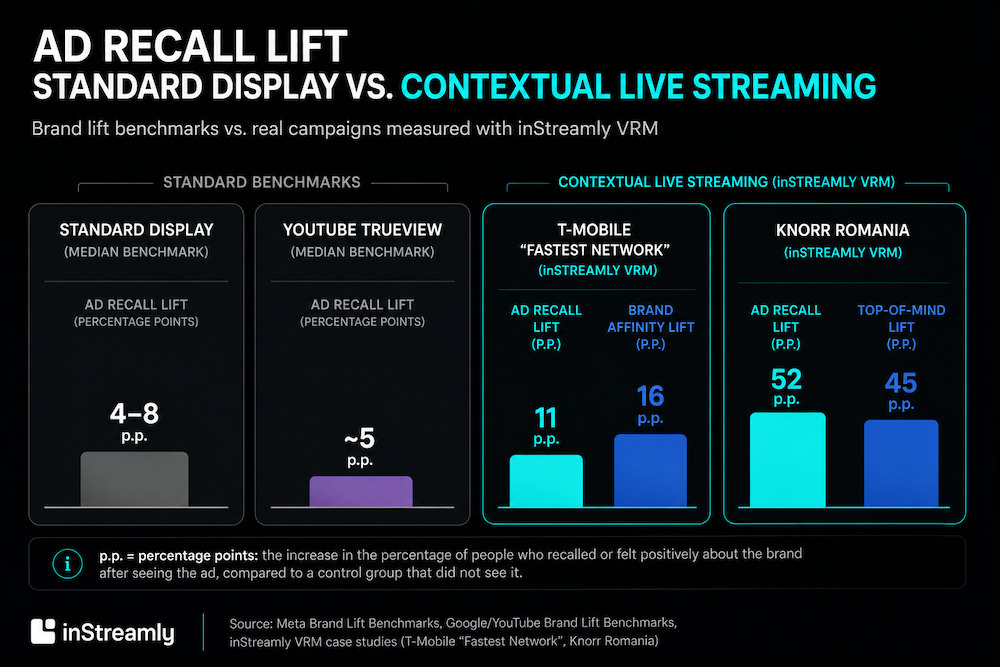
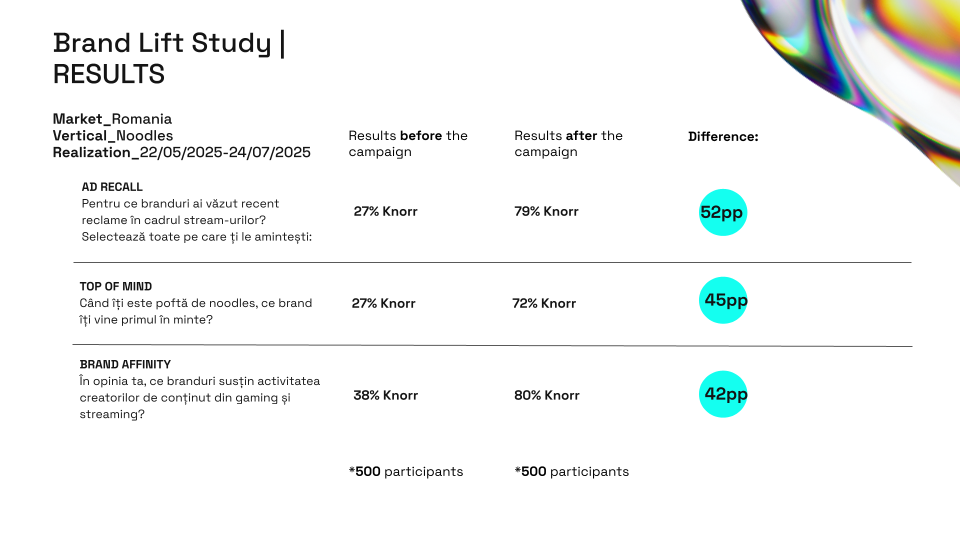
Contextual live streaming campaigns have produced results well above that range. The Knorr Romania VRM campaign recorded a 52 percentage point ad recall lift and a 45 percentage point lift in top-of-mind awareness. The T-Mobile “Fastest Network” campaign produced an 11 percentage point recall lift and a 16 percentage point affinity lift, alongside more than 10,000 organic mentions of the campaign phrase across livestreams. These are not typical display outcomes. They reflect what happens when a brand message arrives at a moment the audience is already paying attention to, rather than during a break in it.
Why standard attribution models fail for gaming and live streaming campaigns
Last-click attribution assigns full credit for a conversion to whatever happened right before it. That model breaks down whenever the exposure itself is not clickable, and most branded content inside a live stream falls into exactly that category.
This is the same structural problem the CTV industry has spent 2025 and 2026 working through. Roughly half of US brand and agency marketers have already shifted toward incrementality testing rather than last-click or multi-touch models, specifically because non-clickable formats need a different proof method: compare outcomes with and without the exposure, rather than tracing a click chain that never existed.
For gaming and live streaming campaigns, three tools replace last-click attribution:
- Brand lift surveys, run through third-party measurement providers, remain the primary method for isolating campaign impact on recall, consideration, and affinity.
- Organic signals such as chat mentions, branded search uplift, and social sentiment monitoring capture behavior that a click-based model would never register. The T-Mobile phrase becoming a naturally repeated line across unrelated streams is a signal no click report could have captured.
- Verified engagement data. Bot traffic inflates click and interaction numbers on any digital channel. Filtering it out, which is what inStreamly’s Verified Clicks system does, ensures that whatever engagement metrics do exist reflect real human behavior rather than invalid traffic.
None of this means gaming campaigns are unmeasurable. It means the measurement has to match the format. A media buyer who insists on last-click reporting for a non-clickable placement will always conclude the campaign underperformed, regardless of what actually happened.
How should you match measurement to campaign objectives?
Different campaign objectives call for different primary metrics. Using brand lift data to judge a conversion campaign, or sales data to judge an awareness campaign, produces a false read either way.
- Awareness objective: reach and frequency, plus unaided recall lift measured through a brand tracking wave.
- Ad recall objective: ad recall surveys run as part of a brand lift study, benchmarked against the campaign’s own control group, not against a competitor’s headline number.
- Affinity objective: brand favorability surveys and social sentiment tracking, since affinity moves slower than recall and needs a longer measurement window.
- Conversion objective: sales data, branded search volume uplift, and direct site traffic, measured through incrementality testing rather than last-click.
Before the campaign launches, set the measurement plan with this checklist:
- Confirm the primary objective and select the one metric that will define success.
- Decide whether last-click attribution applies at all. If the format is non-clickable, plan for a brand lift study or incrementality test instead.
- Set a recall or lift target using a comparable benchmark, not an arbitrary number.
- Identify the control group method before the flight starts. Retrofitting a control group after the campaign runs rarely produces clean data.
- Build in a post-campaign survey window long enough to capture affinity shifts, which move slower than recall.
Key takeaways
- Impressions, clicks, and view rate measure delivery, not effectiveness. A complete measurement stack adds attention, brand lift, and sales impact on top of reach.
- Attention predicts brand recall far better than viewability does, and live streaming audiences produce more of it structurally because they are actively engaged rather than scrolling past content.
- Brand lift studies remain the gold standard for proving impact, and contextual live streaming campaigns have repeatedly outperformed standard display recall benchmarks.
- Last-click attribution does not work for non-clickable formats. Brand lift surveys, organic signal tracking, and verified engagement data fill that gap for gaming and streaming campaigns.
- Match the metric to the objective before the campaign launches, not after the results come in.