For BrandsMarketing08.07.2026

Brand Affinity Explained: Definition, Measurement, and Real Examples
Mountain Dew ran a creator accelerator program built around a Discord community, not a single ad flight. The result was a 28% lift in brand affinity among 16 to 24 year olds and over 71 million organic views from viewers who chose to watch rather than had the content pushed to them. No pre-roll produces that number.
Most brand tracking studies lump affinity in with awareness and loyalty, as if they measure the same thing. They don’t. A brand manager who confuses them optimizes for the wrong number and wonders why recognition keeps climbing while nobody actually prefers the brand.
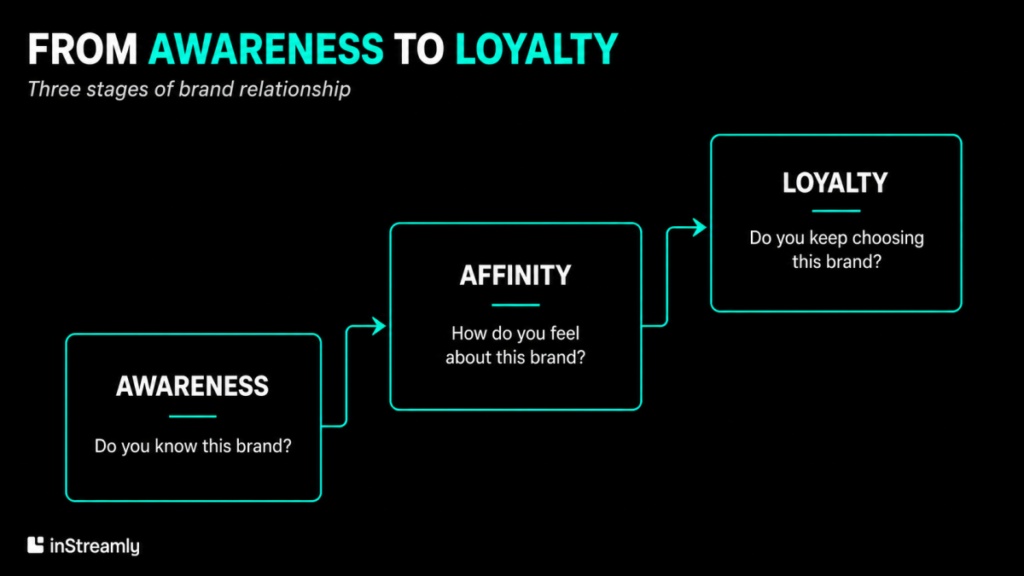
What is brand affinity, and how does it differ from awareness and loyalty?
Brand affinity is the positive emotional association a person holds toward a brand, independent of whether they have bought anything. It sits between two metrics marketers already track, and confusing the three is where most measurement plans go wrong.
- Awareness: do you know this brand? Recognition, nothing more.
- Affinity: how do you feel about this brand? Emotional preference, formed before any purchase.
- Loyalty: do you keep choosing this brand? Repeat behavior, often reinforced by habit or price.
A consumer can be aware of a brand and feel nothing toward it, or loyal out of convenience with no real affinity underneath. Affinity without loyalty rarely lasts, since a positive feeling nobody reinforces eventually fades. That’s why affinity matters most in competitive categories: when products are functionally identical, price stops deciding the outcome, and the brand the audience feels connected to wins.
Affinity builds through shared identity, not persuasion
Affinity forms when a brand becomes part of what an audience already values, not when a brand explains why it deserves to be valued.
What builds it: showing up inside spaces the audience already loves, on the audience’s terms; supporting a community’s existing activity instead of asking for attention; and staying consistent so the brand becomes a familiar presence.
What doesn’t: interrupting an experience and hoping the message lands; a single high-reach placement with no follow-through; and messaging that talks about brand values instead of demonstrating them.
Brands that earn affinity this way don’t just win over buyers. They earn goodwill from the whole community, including people who never convert, and that goodwill later shows up as brand lift.
Why do gaming and live streaming environments build affinity faster than display?
They build affinity faster because viewers read brand presence inside a stream as support for the creator, not as an ad aimed at them.
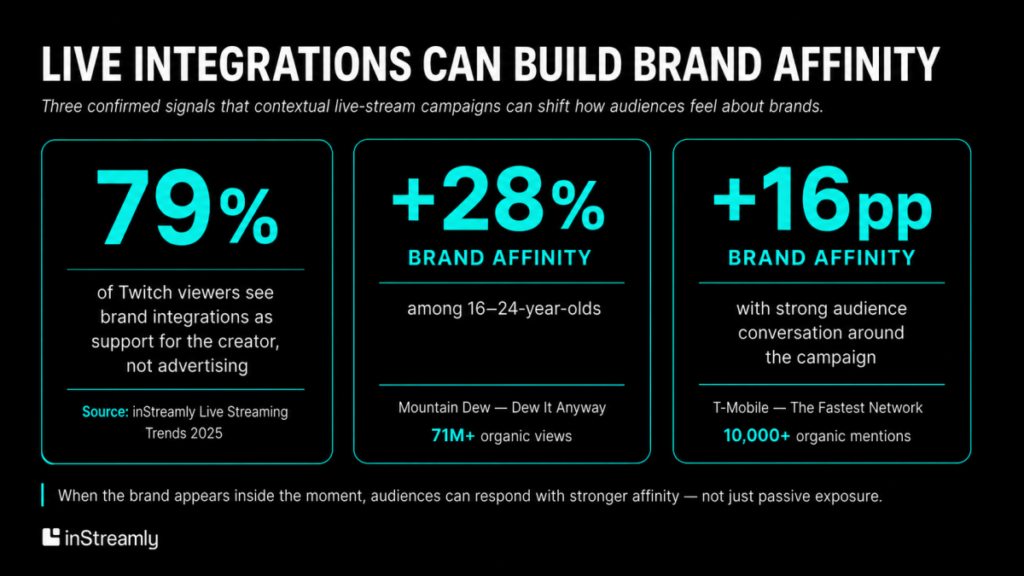
According to inStreamly’s Live Streaming Trends 2025 report, 79% of Twitch viewers see in-stream brand integrations as support for the creator they follow rather than advertising. A brand that sponsors even a small streamer becomes part of the reason the stream exists. That is different from a 15-second spot competing against a scroll to skip it.
Micro-community dynamics make this stronger. Viewers in a smaller community follow brand support the same way they follow the crowd on any other social signal, reading it as a marker of brand values, not just product quality. Two campaigns show the pattern:
- Mountain Dew’s “Dew It Anyway” creator accelerator program built a 3,100-plus member Discord community, generated over 71 million organic views, and lifted brand affinity by 28% among 16 to 24 year olds.
- T-Mobile’s “Fastest Network” VRM campaign let the phrase get triggered organically by streamer speech more than 10,000 times, driving 800,000 views and a 16 percentage point lift in brand affinity.
Neither campaign asked viewers to feel something about the brand. Both let the brand become part of a moment the community was already having.
Brand affinity gets measured through sentiment, not clicks
It’s measured through favorability surveys and sentiment tracking, not impressions or click-through rate, because affinity is a feeling, not an action.
The toolkit includes net favorability (positive view minus negative view), likelihood to recommend or choose (distinct from purchase intent, since it asks whether the brand would be picked given equal alternatives), and brand sentiment scores pulled from social listening, tracking tone rather than volume.
This is easy to confuse with Net Promoter Score, but the two differ. NPS asks whether someone would recommend a brand they already use, a loyalty signal tied to product experience. Brand affinity asks how someone feels regardless of use, making it the right tool for audiences who haven’t converted yet.
The standard design for isolating a campaign’s effect is a pre and post survey against a matched control group with no exposure. Without one, a rise in favorability could reflect market conditions rather than the campaign.
How do you build brand affinity through live streaming, step by step?
Building brand affinity through live streaming follows a repeatable sequence, not a single creative decision.
Step 1: Identify communities that match your brand values or category, starting with ones where the product category is already part of the conversation.
Step 2: Choose a participation model that genuinely helps the community, whether that’s sponsoring creators, enabling reward mechanics like Drops, or funding tournament prizes.
Step 3: Let the community discover the brand through context, not repetition. A brand that shows up because the moment called for it earns more goodwill than one on a fixed schedule.
Step 4: Measure affinity before and after with brand lift surveys or sentiment tracking, since without a baseline there’s no way to isolate what changed because of the campaign.
A quick self-check before greenlighting a plan: does the community care about this category, does the participation model benefit it on its own, is a baseline in place, and is the plan built for sustained presence rather than a single burst?
Affinity compounds over time, if you track the right signals
It compounds when a brand maintains presence long enough for a campaign spike to turn into a structural association, rather than fading back to baseline once the flight ends.
A single burst, even a well-executed one, produces a temporary lift. Sustained presence across multiple creators and months is what turns that lift into something durable. The signs that separate genuine affinity growth from a reach-driven bump: organic community mentions that continue after the paid activity stops, a sentiment shift that holds in tracking waves after the campaign, and an increase in branded search volume not directly prompted by media spend.
Affinity that builds this way feeds directly into loyalty, since a consumer who already feels positively about a brand needs less convincing to choose it repeatedly. That’s the practical reason to track it at all: it’s an earlier, more actionable signal than waiting for sales data to move.
Brand affinity programme review checklist: baseline measurement recorded before activation, a participation model chosen for community benefit rather than reach alone, the campaign sustained across multiple touchpoints, a post-campaign tracking wave to check durability, and organic mentions plus branded search tracked as secondary signals.
Key takeaways
- Brand affinity measures emotional preference, sitting between awareness and loyalty, and it survives price and feature parity with competitors.
- Gaming and live streaming build affinity faster: 79% of Twitch viewers read brand integrations as creator support, not advertising.
- Affinity is measured with favorability surveys against a control group, and it compounds into loyalty through sustained presence, not a single burst.