
Loss Aversion in Marketing: Why Consumers Fear Loss More Than They Value Gain
Why does “Offer Ends Tonight” feel more compelling than “Special Offer Available”? Why are free trials so effective at converting users into paying customers?
The answer lies in loss aversion – a core principle of behavioral economics showing that people experience losses more intensely than equivalent gains. For marketers, this asymmetry explains why urgency, scarcity, and risk-based messaging often outperform purely benefit-driven communication.
What Is Loss Aversion?
Loss aversion is a cognitive bias where the pain of losing something feels stronger than the pleasure of gaining something of equal value.
The concept was introduced by Daniel Kahneman and Amos Tversky in 1979 as part of Prospect Theory, which demonstrated that people evaluate outcomes relative to a reference point and weigh losses more heavily than gains. Research summarized by Lead Alchemists notes that losses are often felt roughly twice as strongly as equivalent gains. This imbalance influences financial decisions, everyday behavior, and purchasing choices.
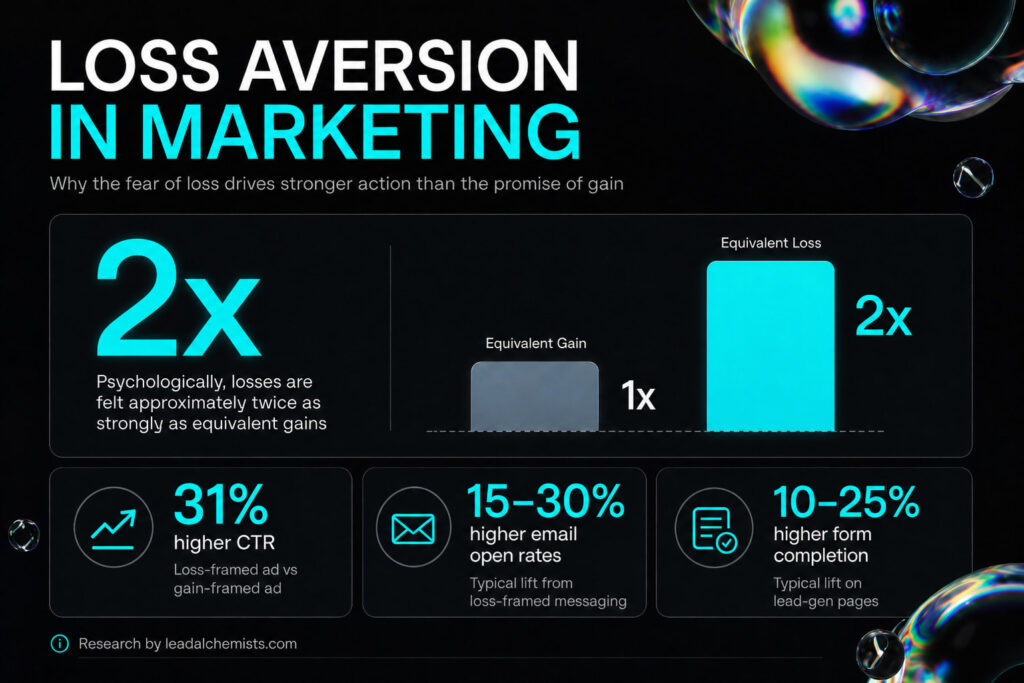
Prospect Theory and Consumer Decision-Making
Prospect Theory challenged the idea that consumers are purely rational decision-makers. Instead of evaluating absolute value, people assess potential outcomes relative to what they currently have – or expect to have.
Cognitive Clicks explains that loss aversion helps clarify why individuals are more motivated to avoid losses than to pursue comparable gains, often leading to cautious or risk-averse behavior.
In marketing, this means:
- Highlighting a benefit appeals to opportunity.
- Highlighting a potential loss appeals to protection.
Protection tends to feel more urgent.
How Loss Aversion Influences Buying Behavior
1. Urgency Feels Personal
When messaging emphasizes what a customer might lose – access, price, availability – the decision becomes emotionally charged. Scarcity signals such as limited stock or time-bound offers trigger action because inaction now carries a perceived cost.
Loss framing shifts the question from “Should I buy?” to “Can I afford to miss this?”
2. Ownership Changes Perception
Loss aversion intensifies once people feel ownership.
Lead Alchemists highlights that free trials are effective because once users experience premium features, losing them feels like a real loss – even though they originally had no access.
This perceived ownership transforms a neutral decision into a defensive one.
3. Inaction Becomes Risky
When potential losses are visible, doing nothing feels unsafe. This is why risk-based messaging works particularly well in industries such as finance, insurance, healthcare, and cybersecurity.
Consumers are often more responsive to preventing negative outcomes than achieving incremental improvements.
Loss Aversion in Marketing: Practical Applications
Scarcity and Limited Availability
Messages such as:
- “Only 2 seats remaining”
- “Offer expires at midnight”
- “Last chance to register”
activate loss sensitivity by emphasizing what disappears if action is delayed.
The effectiveness depends on credibility. Artificial scarcity undermines trust.
Loss-Framed Value Propositions
Instead of focusing exclusively on gains:
Gain-framed:
“Increase your conversion rate.”
Loss-framed:
“Stop losing customers at checkout.”
According to Cognitive Clicks, loss aversion consistently drives people to prioritize avoiding negative outcomes over pursuing gains.
This approach is particularly effective in lead generation and B2B marketing, where the cost of inaction can be quantified.
Free Trials and Subscription Models
Free trials reduce initial friction, but their conversion strength lies in habit formation. Once users integrate a product into daily workflows, cancellation feels like giving something up rather than declining an upgrade.
Designing onboarding to create early value increases the psychological cost of leaving.
Loyalty Programs and Retention
Accumulated rewards create a sense of ownership. Points, benefits, or tier status feel earned, and losing them becomes aversive.
Loss aversion here strengthens retention rather than initial acquisition.
Why Loss Aversion Increases Conversions
Loss-based framing works because it:
- Reduces procrastination
- Increases urgency
- Heightens emotional engagement
- Raises perceived opportunity cost
When the cost of inaction becomes salient, the threshold for decision-making lowers.
Consumers may delay gains.
They rarely delay preventing losses.
Ethical Use of Loss Aversion
Because loss aversion is powerful, it must be applied responsibly.
Lead Alchemists emphasizes that marketers should avoid fake urgency or misleading scarcity. Loss framing should reflect genuine constraints or real consequences.Ethical implementation includes:
- Transparent deadlines
- Honest stock limitations
- Clear subscription terms
- Avoiding exaggerated risk
The objective is clarity and motivation, not fear exploitation.
When to Be Careful
Excessive fear-based messaging can:
- Increase anxiety
- Damage brand trust
- Reduce long-term loyalty
Balanced communication performs better over time. Combining loss prevention with positive outcomes maintains credibility while preserving persuasive impact.
What This Means for Modern Marketing
Loss aversion marketing is not about manipulation. It is about aligning communication with how decisions are actually made.
Consumers evaluate choices relative to what they stand to lose. Prospect theory demonstrates that losses carry greater psychological weight than equivalent gains, and this principle applies across industries and audiences.
Marketers who understand this can:
- Frame offers more effectively
- Improve urgency without heavy discounting
- Increase trial-to-paid conversions
- Strengthen retention strategies
In competitive markets, messaging that protects value often outperforms messaging that promises more of it.