Elevating Unity: The Top 5 Inclusive Gaming Campaigns
Not long ago, an inclusive gaming campaign was an easy yes for most brand teams. Reputational upside, low risk, and a way to reach an audience that ignores standard advertising. In 2026 the calculation looks different. After a wave of policy changes in early 2025, diversity and inclusion became a politically charged subject, and brands started reading every inclusion decision as a risk question. The numbers around that retreat are worth keeping in front of you before you plan anything.
Target pulled back on its diversity commitments in early 2025, faced a 40-day boycott, and lost about 12.4 billion dollars in market value while early-year store visits fell by 5 million. Costco kept its commitments and saw shopper visits rise by 7.7 million over the same period. This article looks at five inclusive gaming campaigns and what the current consumer and business data says about whether they still make sense for your brand.
Why inclusive gaming campaigns look different in 2026
The shift is political, not commercial. Consumer demand for inclusion did not fall in 2025. What changed is the cost of getting it wrong in either direction.
For a marketer, that combination is the actual problem. The audience wants inclusion but distrusts the label. So the question for 2026 is not whether inclusion matters to your gaming audience. It is how to act on it without making the brand the story.
Is gaming only for young men?
The audience data says no and the gap between the stereotype and the audience is the commercial reason inclusive campaigns work. Women make up close to half of all players worldwide, yet hold only around 30% of the jobs inside the industry that decides how they are represented. The audience for a game is rarely the audience the marketing assumes. The Sims is a clear example. Its developer has said only about 21% of players are men, which means most of the people buying and playing one of the best-selling franchises in history are not the demographic most gaming ads target.
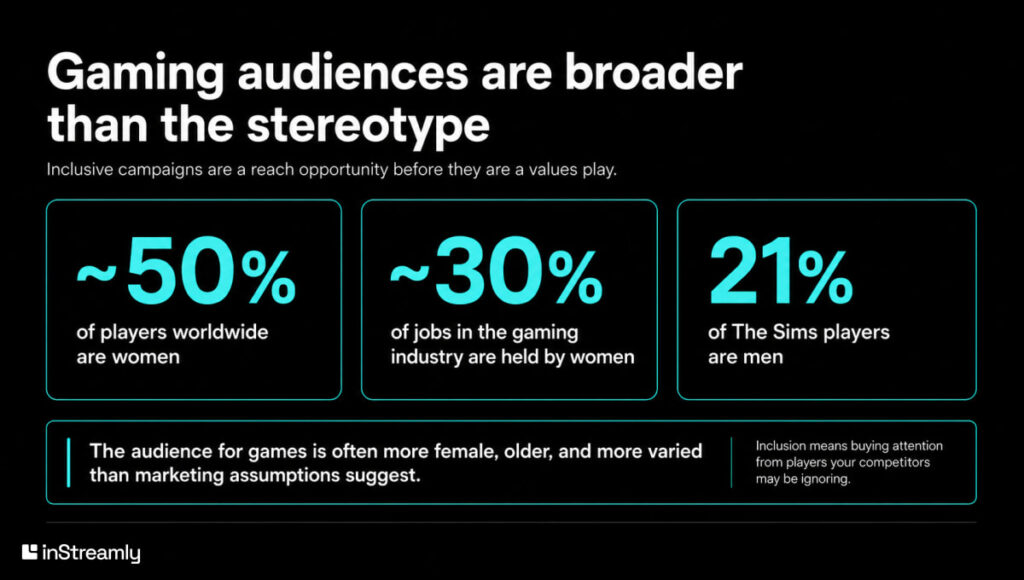
Reaching underserved players is a reach play before it is a values play. inStreamly’s own breakdown of who plays and watches games in 2026 shows an audience that is older, more female, and more varied than the teenage-boy shorthand most media plans still carry. Inclusion, in practice, means buying attention from people your competitors are ignoring.
Five inclusive gaming campaigns worth studying
The campaigns below span product design, representation, and community. Each one reached a specific audience for a specific reason, which is what separates them from a logo on a rainbow background.
O Boticário and ‘Heroínas do Game’
The Brazilian beauty brand O Boticário built a campaign around female VALORANT streamers rather than a generic gaming sponsorship. It worked with top local creators and sponsored women streamers in a format that reacted to in-game events in real time, so the brand appeared at the moments that mattered inside the broadcast instead of interrupting them. The reason it holds up is the mechanism. Reaching female gaming audiences through women creators, with brand moments tied to live gameplay, is reach and relevance at once. The full breakdown is in our case study on the O Boticário campaign.
The Sims 4 and inclusion built into the product
EA and Maxis put inclusion into the character creator rather than into an ad. The Sims 4 added customizable pronouns in 2022, then trans-inclusive and disability options in 2023, including chest binders, top surgery scars, hearing aids, and glucose monitors, all in the base game. The franchise reached its 25th anniversary in 2025 with one of the most varied player communities in gaming. There is a 2026 caveat a marketer should note. After EA was taken private in late 2025 by a group that includes Saudi Arabia’s Public Investment Fund and Jared Kushner’s firm, some players have raised questions about the future of that representation. Product-level inclusion is durable, but it still depends on who owns the product.

Dove and Real Virtual Beauty
Dove worked at the development layer instead of the campaign layer. Through its Real Virtual Beauty coalition with Women in Games and Epic Games’ Unreal Engine, the brand pushed for more realistic representation of women and girls in the games themselves, tying the work to its long-running self-esteem positioning. For a non-endemic brand, the lesson is that the most credible inclusion play can sit upstream of the ad, in the content the audience actually spends time with.
Lenovo and the Silver Snipers
Lenovo Legion built the first senior professional Counter-Strike team, the Silver Snipers, with players aged from their mid-60s to mid-70s. The team won a senior world cup at DreamHack and became a recurring story about age and loneliness rather than a one-off stunt. The campaign predates the move from CS:GO to Counter-Strike 2, so treat it as a benchmark rather than a live activation. Its value is the demographic it owned. Almost no brand was speaking to older players, and Lenovo took that space.
Xbox and Retirement Villages
Xbox, Retirement Villages, and agency McCann put consoles into UK care homes to connect older residents with their grandchildren through play. The inclusion here was utility, not messaging. The brand delivered something the audience could use, and the story followed from the use. For a marketer weighing risk in 2026, campaigns built on a genuine function are far harder to read as performative than campaigns built on a statement.
Why is accessibility the safest inclusion play right now?
Because it widens the addressable audience while drawing the least political heat. Accessibility is inclusion that almost no one argues with, and the industry has moved on it fast.
- In the 2025 Game Developers Conference survey, 71% of developers said they were committed to making games accessible across diversity, equity, and inclusion.
- Mattel committed to making 90% of its games colorblind-accessible by the end of 2025, in a market where more than 300 million people are colorblind.
- The Last of Us Part II is widely treated as a benchmark for accessible design.
For a brand, accessibility is the rare inclusion move that grows the buyer base and carries little backlash risk. It is a feature, not a position.
What pulling back actually costs
The cost of retreating is now measurable, and it falls hardest on younger and higher-spending audiences.
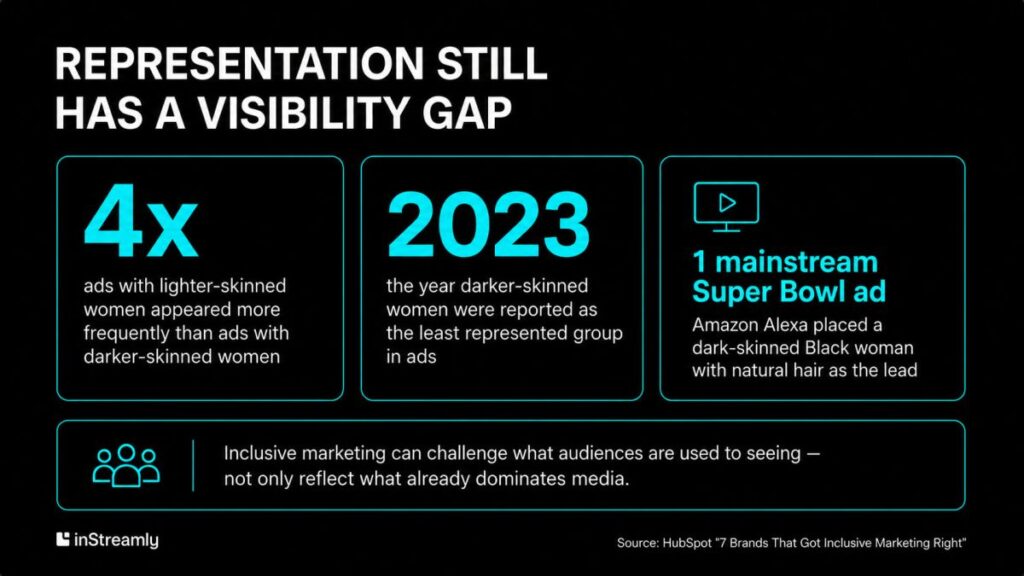
- Companies holding their commitments saw purchase consideration rise, while those that rolled back saw brand momentum turn negative. Three times more consumers said the steady brands were on the rise than on the decline.
- When a brand keeps inclusion in place through a backlash, support rises for 57% of Gen Z consumers, against 35% of baby boomers. Researchers call the quieter version silent attrition, where customers leave without saying why.
- Global LGBTQ+ spending power is around 4.7 trillion dollars a year, and that audience over-indexes on creator and streaming media exactly where gaming attention lives.
None of this means inclusion is risk-free. Performative campaigns draw criticism, and audiences that grew up online spot a brand changing its values with the political weather. Context matters too. The backlash that dominated United States headlines in 2025 did not play the same way everywhere, and support for inclusion rose in some markets over the same period. The practical reading is not to say more, but to mean it and adapt it to where the campaign runs. Brands that handle this badly can trigger the kind of community reaction covered in our look at what gaming communities reward and punish.
How do you run an inclusive gaming campaign without the backlash trap?
Tie it to a real business and product reason, then deliver something useful rather than a statement. The campaigns that held up above share that trait. They reached a specific audience or solved a specific problem, and the inclusion was the mechanism, not the message. A short checklist for planning one in 2026:
- Start from reach. Identify the players your category ignores, then build for them. Inclusion that opens a new audience defends itself commercially.
- Lead with accessibility where you can. It grows the buyer base and carries the least risk.
- Bring the community into the work, not just the sign-off. Audiences can tell when representation was made with them rather than approved at the end.
- Use contextual relevance over interruption. Brand moments tied to live gameplay or creator content, as in the O Boticário work, read as part of the experience rather than an ad.
- Adapt to the market. The same campaign can land differently across regions, so check local context before you run it.
- Report outcomes, not slogans. Tie the campaign to reach, brand lift, and sales signals you can show a skeptical media buyer.
Conclusion
Inclusive gaming campaigns still work in 2026, but the bar for doing them well has moved.
- The audience demand is intact. Most consumers reward clear commitment and penalize retreat, and that effect is strongest among Gen Z and higher spenders.
- The safest, highest-reach version is accessibility, which grows the buyer base with little political risk.
- The campaigns that hold up reach a real audience or solve a real problem, with inclusion built into the mechanism rather than added as a message.
Endemic or not, as you can see, any brand can run an inclusive gaming campaign. However, it is always important to have the right values and respect for all gamers.