For BrandsMarketing07.07.2026

Brand Recall Survey: What It Measures, How to Run One, and What Results Mean
A campaign dashboard can show impressions, clicks, and reach climbing every day. None of those numbers answer the question that actually predicts whether the spend paid off: when a shopper thinks about the category next week, does your brand come to mind?
That is what a brand recall survey measures: the gap between exposure and memory. For gaming and live streaming campaigns, that gap tends to close faster than most media planners expect.
What brand recall actually measures
Brand recall is whether someone can name your brand without being shown it. There are two ways to test this, and they are not interchangeable.
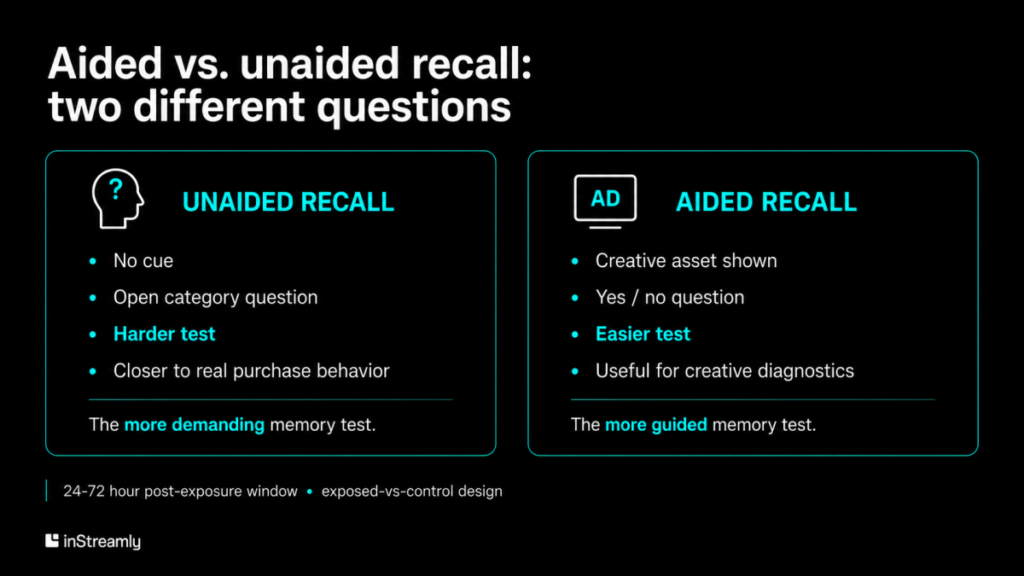
Unaided recall asks an open question: “Which brands come to mind when you think of energy drinks?” No logo, no list, no cue. The respondent has to retrieve the brand from memory on their own.
Aided recall shows the respondent a creative asset or a brand name and asks if they remember seeing it. It is an easier test, because recognition takes less cognitive work than retrieval.
Brand recall is often confused with brand recognition, but they measure different things. Recognition asks “have you seen this before?” Recall asks “can you produce this from memory, unprompted?” Unaided recall is the harder test and the more commercially useful one. It mirrors what happens when a shopper stands in front of a shelf with no ad in sight and has to decide what to buy.
How do you design a brand recall survey?
A brand recall survey is built around three decisions: the question type, the timing of the interview, and the composition of the comparison group.
- Question type. Choose aided, unaided, or both. Unaided alone is the strictest test of lasting memory.
- Timing. Post-exposure interviews typically run 24 to 72 hours after exposure. Too soon and short-term memory inflates the result. Too late and you lose signal.
- Exposed vs. control group. Recall lift is the gap between people who saw the campaign and a holdout group who did not. Without a control group, you measure absolute recall, not what the campaign added.
One mistake shows up often enough to name directly: the audience alignment trap. If the exposed and control groups are not matched on age, platform use, or category interest, the recall gap you measure reflects a difference between the groups, not the campaign’s effect.
What drives recall in a live stream environment
Four mechanisms explain why contextual live streaming campaigns tend to build recall faster than standard formats.
- Frequency inside a trusted format. A phrase or visual repeated across a stream the viewer already chose to watch reinforces memory without repeated interruption.
- Context relevance. A brand appearing at the moment it is relevant to what is happening on stream gets processed differently than an ad inserted on a fixed schedule.
- Emotional connection. Viewers are watching a person they follow by choice, not a channel they tolerate. That changes how content lands.
- Active attention. 73% of stream viewers actively participate in chat rather than watching passively, per inStreamly’s Live Streaming Trends 2025 report. Active participation predicts recall better than passive exposure.
How do live streaming benchmarks compare to display advertising?
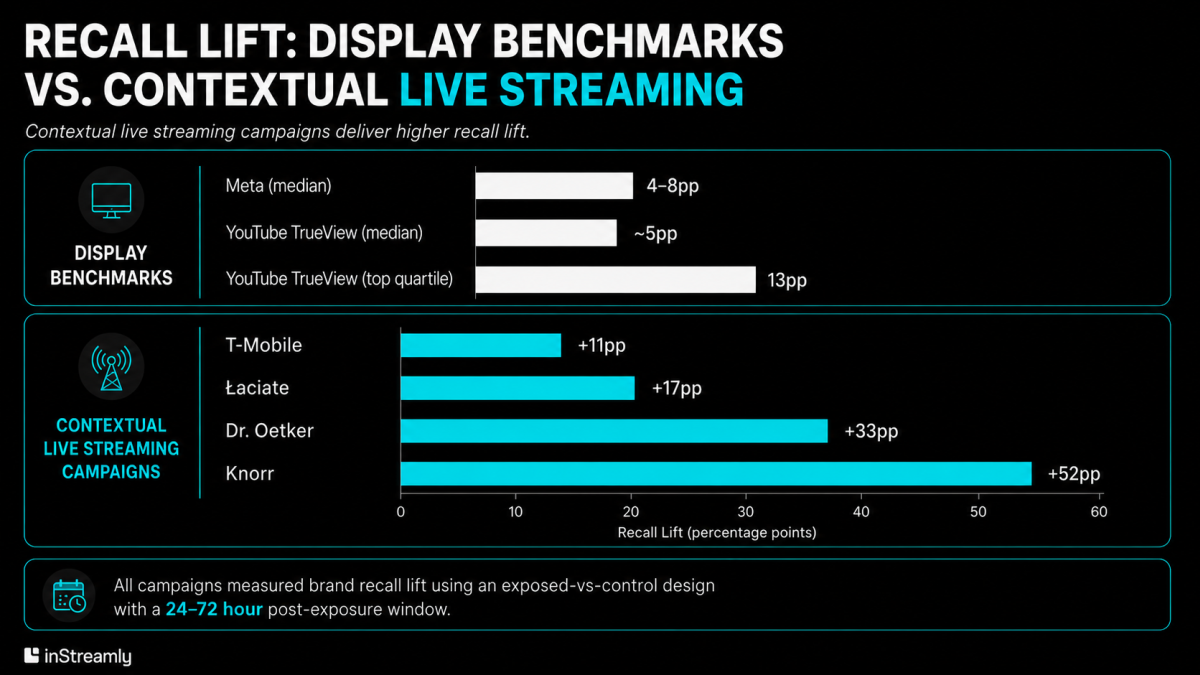
Contextual live streaming campaigns post recall lifts that run several multiples above typical display benchmarks. Meta’s aggregate data puts median ad recall lift for typical campaigns between 4 and 8 percentage points, with strong video creative reaching 15 to 25 points. Google’s benchmarks for YouTube TrueView show a median lift of roughly 5 points, with top-quartile campaigns exceeding 13.
inStreamly campaigns have posted results well above those ranges:
- Knorr’s VRM campaign in Romania produced a +52pp ad recall lift, among the highest brand lift results recorded for a non-endemic FMCG brand in a streaming context.
- Dr. Oetker’s Guseppe campaign delivered a +33pp ad recall lift using 1,896 personalized creatives, one built per streamer.
- Mlekpol’s Łaciate Protein+ tournament produced a +17pp ad recall lift.
- T-Mobile’s “The Fastest Network” campaign generated +11pp of brand recall through more than 10,000 organic streamer mentions, triggered by Voice Recognition Mechanism rather than scripted placement.
Brand recall vs. brand recognition vs. brand awareness: which one should you track?
The metric to prioritize depends on the funnel stage the campaign targets. The three sit in a hierarchy:
- Brand awareness: the broadest measure. Does the audience know your brand exists at all?
- Brand recognition: sits inside awareness. Shown your logo or creative, does the audience identify it as yours?
- Brand recall: the strictest test inside recognition. With no cue at all, does your brand surface from memory?
Use this checklist to pick the right metric:
- New brand entering a category? Track awareness first. Recall benchmarks mean little if the audience does not know the brand yet.
- Campaign built around one creative or a repeated phrase? Track recognition and aided recall to see if the asset is landing.
- Trying to prove the campaign changed what comes to mind unprompted? Track unaided recall. It is the harder number to move and the one that matters most for consideration.
Why brand recall matters more than marketers think
Recall sits between exposure and purchase, and it does the work neither impressions nor clicks can do alone. A shopper does not compare every brand in a category before buying. They choose from a short mental list, usually three to five names, built before they reach a shelf or a search bar. If your brand is not on that list, the rest of the funnel never gets a chance.
That is why the T-Mobile result matters beyond the headline number. The phrase became the most-repeated line in gaming streams that quarter, meaning the brand entered viewers’ vocabulary before any purchase moment came up. A strong recall number is evidence of exactly that: a brand that will show up on the short list when it counts.
For how ad recall lift is calculated and who runs these studies, see inStreamly’s guide to ad recall measurement. For the mechanics behind why some exposures build memory and others do not, see inStreamly’s breakdown of attention metrics.
Key takeaways
- Unaided recall is the stricter, more commercially relevant test: what a shopper can name with no cue, closer to the point of purchase.
- A valid survey needs a matched exposed-vs-control design and a 24-72 hour post-exposure window. Skipping either makes the number untrustworthy.
- Contextual live streaming campaigns have posted recall lifts of +11pp to +52pp, several multiples above the 4-8pp median typical of display.