Gaming influencers vs. live stream advertising: Where should brands invest?
In 2025, Unilever said it would move from about 30% to 50% of its media budget into social and creator content, and work with 20 times more influencers, as The Drum reported on Unilever’s influencer-first strategy. Other large advertisers are following. The debate about whether creators belong in the media plan is over.
For brands that want to reach gamers, a narrower question is still open. Where is the relationship between a gaming creator and their audience actually built, and how does a brand buy into it?
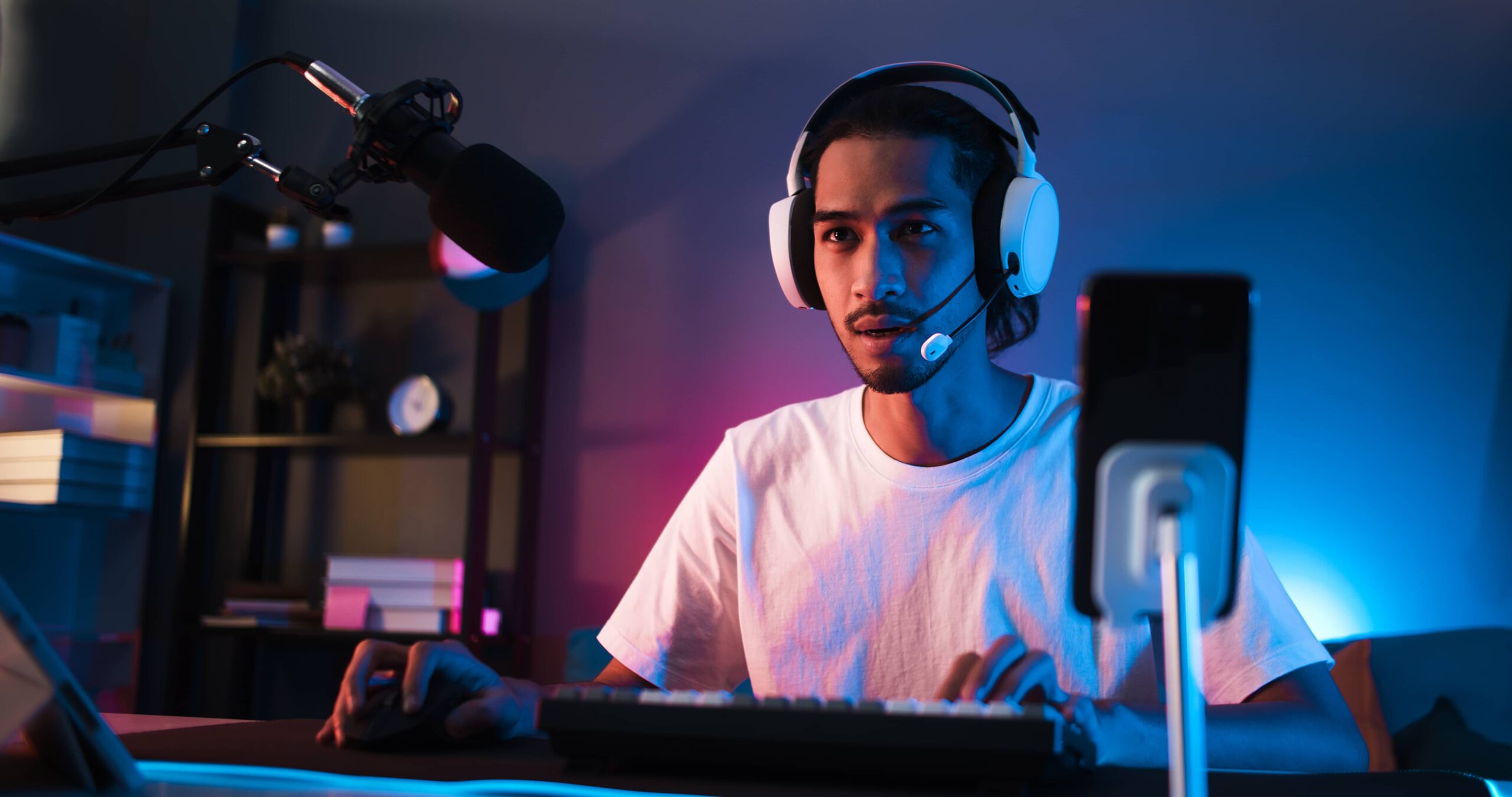
A sponsored reel from a gaming creator reaches people in a feed, one scroll at a time. The same creator spends hours each week live on Twitch, Kick or YouTube, with an audience that talks back in chat. Many of the clips that later travel on TikTok and YouTube are cut from those streams.
That leaves a gaming media plan with two ways to buy creator attention. One is a deal with a single creator. The other is a network campaign that places the brand inside hundreds of live streams at once.
Why influencer marketing is where the budget is going
Creators earn a kind of trust that paid media struggles to buy. In the Modash Creator Trust Report 2026, a survey of 1,042 US adults, 40% said they trust creators. Among Gen Z, the figure was 60%.
Trust grows with exposure. Respondents who interact with creator content every day were far more likely to call creators trustworthy. Creators people follow ranked second among sources of product recommendations, level with online reviews and behind only friends and family.
The same report shows how quickly that trust breaks:
- 36% trust a creator less when they read from a script or repeat marketing talking points
- 43% trust a creator less when the product looks like a poor fit for their content
For a brand, this is the practical risk. Buying a creator and handing them a rigid script spends the trust you paid for in a single post.
Where do gaming creators actually build their audience?
Gaming creators build their audience on live streams. Many have bigger followings on YouTube or TikTok, but the material for those channels is usually recorded live and edited afterwards. Jokes, rivalries and in-game moments happen on stream first. Short-form clips are the second life of that content.
That audience also listens when it comes to spending. According to Visa’s research on gaming spend in Europe, 28% of gamers say content creators play an important role in their spending decisions. Seven in ten Gen Z gamers engage with gaming creators at least once a week.
The platform matters as well. CivicScience data from November 2025 shows that Twitch viewers are more likely than YouTube, TikTok and Instagram users to trust influencers. They are also more likely to have bought something on an influencer’s recommendation. Live viewing is growing beyond Twitch too. YouTube Gaming had its best live year in 2025, with 8.8 billion hours watched, according to Stream Hatchet’s 2025 Live Streaming Trends Report.
The games people play most are also the games they watch most:
- On streams: League of Legends led 2025 with 1.95 billion hours watched, ahead of GTA V and Counter-Strike, according to Stream Hatchet’s ranking of the top games on live streaming for 2025
- In play: Counter-Strike 2 and Dota 2 hold the top two spots on Steam’s most played chart at the time of writing, and FiveM, the platform for GTA V roleplay servers, sits in the top five
For a brand, the overlap is useful. Streams are where the most active players spend time when they are not playing themselves.
What does “live” add that a post can’t?
Live viewing creates a stronger sense of connection with the creator, and this effect has been measured. Researchers from the University of Texas, the University of Colorado and the University of Southern California ran five experiments with 3,500 participants, including viewers on Twitch. Their results, published in the Journal of Marketing and summarized by McCombs School of Business, show a clear “liveness lift”:
- Viewers felt 7 percentage points more connected to the performer in the live version
- Viewers enjoyed the live version 5 percentage points more
- Live viewers kept watching longer and were more willing to follow or subscribe
In one experiment, the video itself was identical. The only difference was whether viewers believed it was happening in real time.
Time spent adds to that effect. According to inStreamly’s Live Streaming Trends 2025 report, 77% of livestream viewers watch more than five hours a week, and 73% actively take part in chat.
A post earns a moment of attention. A brand inside a stream sits in a setting the viewer chose, repeats across a session, and appears while people are talking about what they see. The article Live Advertising in 2026: Formats, Examples, and Why Live Stream Ads Earn Different Attention covers the formats in more detail.
One creator deal vs a network campaign: the comparison that matters
In gaming, most brands are not choosing between Instagram and Twitch. They are choosing between a deal with one well-known creator and a campaign that runs across many streamers at once.
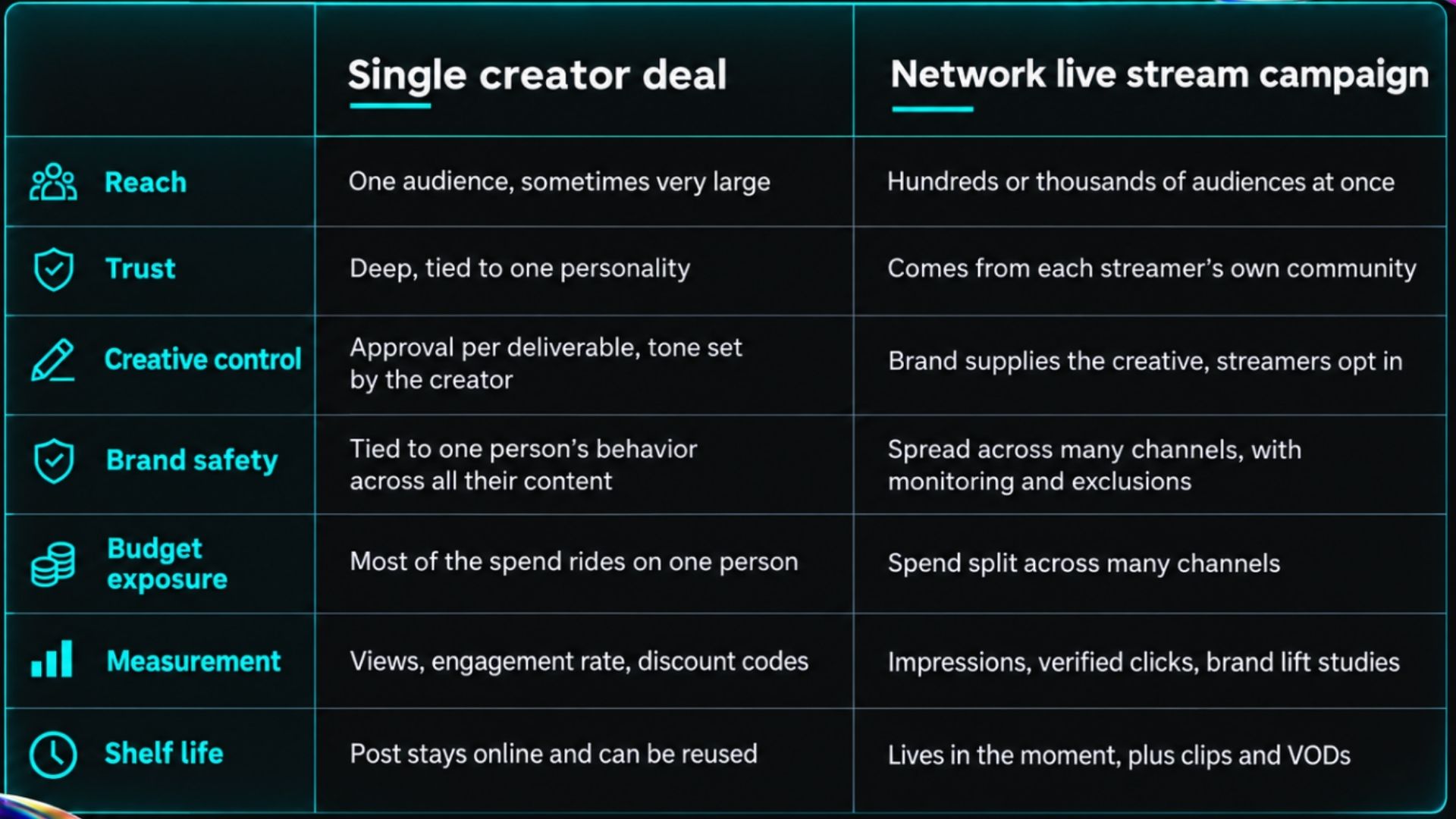
A single creator deal is strong when the brand needs a face, a product demo or a story that one personality can tell well. Its weakness is concentration. As The Drum noted in its coverage of Unilever’s shift, a budget spent on influencers is a budget the brand does not fully control.
A network campaign is strong when the goal is reach, frequency and recall across a whole audience. Its weakness is depth, because no single streamer becomes the face of the brand. For a closer look at the tiers, see Streamer Sponsorships: How Brands Partner with Live Streamers.
How do contextual formats make stream advertising work at scale?
Contextual formats tie the brand to what is happening in the stream. The message appears when it makes sense, not on a timer, and the streamer never has to read a script. This answers the trust problem from the Modash data directly.
Three mechanisms do most of the work:
- Voice recognition. A branded animation appears when the streamer says a trigger phrase in natural speech.
- Chat analysis. Branded elements react to keywords typed by viewers.
- Gameplay analysis. The brand appears at in-game moments such as a win, a loss or a low energy bar.
Two campaigns show how this works in practice:
- T-Mobile. In How T-Mobile made livestreamers say ‘The Fastest Network’ over 10,000 times, 275 streamers said the brand phrase more than 10,000 times. The campaign lifted brand affinity by 16 percentage points and brand recall by 11.
- Dr. Oetker Guseppe. Each of 1,896 streamers chose their favorite pizza and got an overlay with their own name and recommendation. Viewers posted over 48,000 pizza-related chat messages, and ad recall rose from 45% to 78%, according to the Guseppe case study.
Across 33 brand lift studies in the first half of 2026, inStreamly campaigns raised ad recall by an average of 19 percentage points, as shown in the Q1-Q2 2026 Brand Lift Performance report.
When to use each, and how to run both
Each model answers a different brief.
Choose a single creator deal when you need:
- A recognizable ambassador for a launch or a long-term platform
- Product demonstrations, unboxing or tutorials
- Content with a long shelf life on YouTube, Instagram or TikTok
- Access to one specific community, such as a single game or genre
Choose a network live stream campaign when you need:
- Reach across a broad gaming audience. 73% of stream viewers are aged 16 to 34, according to inStreamly’s Live Streaming Trends 2025 report
- Recall and frequency goals tracked through brand lift
- A short launch window with many channels running at once
- Reach among ad-blocking audiences. 64% of gamers use ad blockers, according to the same report
Run both when the budget allows. Film the creator partnership on stream, then cut it into clips for YouTube, Instagram and TikTok. Use a network campaign to carry the same message across thousands of other channels.
Mountain Dew’s “Dew It Anyway” program followed this pattern. As described in “Dew It Anyway” – How Mountain Dew proven its authenticity in gaming culture, the brand ran a creator accelerator for 50 young creators. Established creator Friz acted as a mentor, and his involvement alone generated 24 million impressions. Participants produced content for TikTok and Instagram before moving to live streaming. In parallel, nearly 2,000 streamers carried contextual Mountain Dew placements, which delivered over 1.6 million impressions at a 1.62% click-through rate. Top-of-mind awareness rose from 16% to 33%, and sales value grew 33% in the first year.
Key takeaways
- Creators hold the trust, and in gaming that trust is built live. Twitch viewers trust influencers more than YouTube, TikTok or Instagram users, and live viewing measurably raises connection and enjoyment.
- The real decision is one creator or many streams. A single deal buys depth and a face. A network campaign buys reach, frequency and recall, with lower exposure to any one personality.
- The strongest plans combine both. Use creator partnerships for stories and evergreen clips, and a contextual network campaign to repeat the message across the audience where it watches most.