For BrandsMarketing13.07.2026
Loot boxes, FOMO, and fake scarcity: 8 dark patterns brands must audit before launching in Roblox
The Roblox metrics your agency shows you don’t tell you if the game is any good
Roblox has 380 million monthly active users, and roughly 40% of its daily audience is under 13. That number alone should shape every brief written for the platform, but it usually shapes something else instead: the pitch deck. Session time, unique visitors, and completion rate get pulled into a report, and the report gets treated as proof that the campaign worked. Nobody on the brand side actually played the game start to finish.
That gap matters more now than it did two years ago. In April 2026, Roblox settled with attorneys general in West Virginia, Alabama, and Nevada for a combined $35.8 million over failures to protect children from predatory contact. A month later, EPIC joined Fairplay and the National Center on Sexual Exploitation in a Federal Trade Commission complaint that went further, accusing Roblox of using engagement-maximizing design and a currency system that hides real costs from children who cannot calculate what they are spending. The platform is also defending more than 140 federal lawsuits. Brands building inside Roblox are not entering a neutral space. They are entering a platform under active regulatory and legal scrutiny for the exact category of design decisions a branded experience has to make.
This article covers two separate problems that get mixed together in most Roblox briefs:
- Predatory mechanics: gambling-style rewards, currency tricks, and manufactured urgency that genuinely harm children and expose brands to real risk.
- Metrics-driven design: mechanics built not to make a good game, but to make a metrics slide look good.
Neither produces what a brand actually wants, which is a positive association with a player who remembers the experience.
Why is Roblox under regulatory pressure right now?
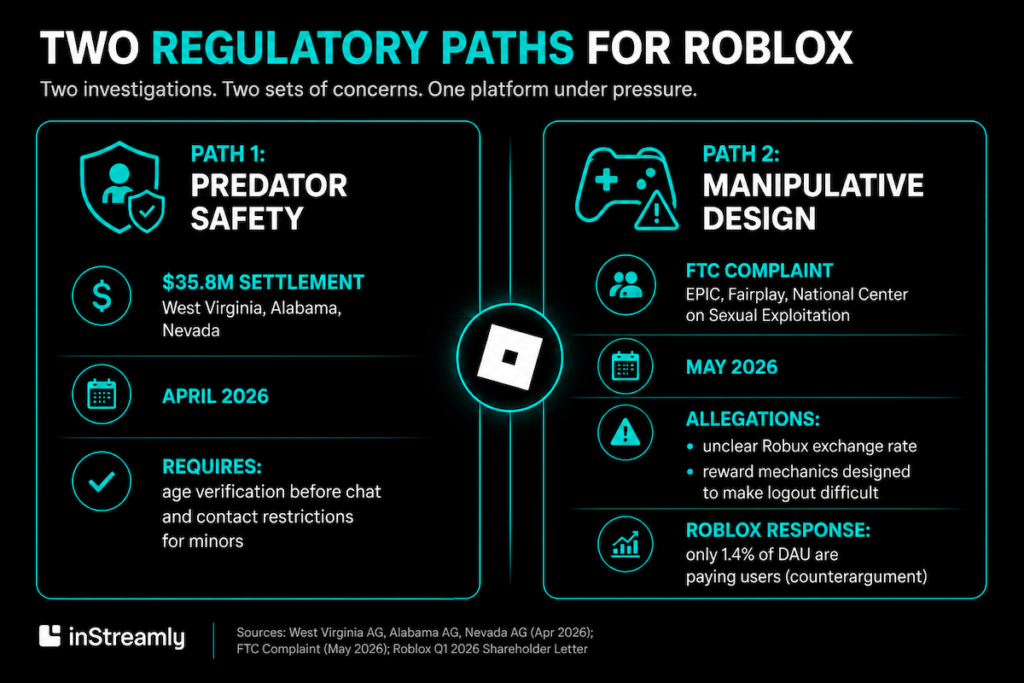
Roblox’s regulatory exposure now sits on two separate tracks:
- Predator safety: the $35.8 million settlement, which requires Roblox to verify user ages before allowing chat and to restrict how minors can be contacted.
- Manipulative design: the FTC complaint filed in May 2026, which argues that Roblox’s exchange rate between dollars and Robux varies by bundle size in a way that makes it functionally impossible for a child to know what anything costs, and that the platform’s reward loops are built to make it hard for kids to log off.
Roblox disputes the claims and says only 1.4% of its daily users are paying customers in a given quarter, but the complaint is now sitting with a federal regulator, and the design patterns it names are patterns that plenty of branded experiences already use without anyone flagging them.
None of this means Roblox is off-limits. It means the platform’s own incentives point toward the same manipulative mechanics a brand should be actively avoiding, and a brief that doesn’t name that risk is an incomplete brief. The same principle shows up in other regulated categories entering gaming. Financial brands face a comparable line between educational value and exploitative design, and the audit process looks almost identical.
The predatory mechanics a branded game can inherit without meaning to
Loot boxes and chance-based rewards. These are already classified as gambling in Belgium, Finland, and the Netherlands. Inside Roblox, they show up constantly. In Pet Simulator 99, one of the platform’s most-played titles, the odds of pulling a rare item sit around 0.05%, and players are prompted to buy more chances the moment they miss. A 2025 CHI Conference study found that Roblox creators have openly described designing these mechanics specifically to drive spending among younger players.
The Robux currency layer. Robux is sold in bundles where larger purchases return a better exchange rate, so the real cost of any item shifts depending on how much a player has already spent. The FTC complaint calls this out directly, and it echoes a $20 million FTC settlement with Cognosphere, the maker of Genshin Impact, over a nearly identical mechanic. A branded experience that gates content behind Robux purchases is operating inside that same currency confusion, even when the branded content itself is free.
Manufactured urgency. Limited-time cosmetics and countdown-driven battle passes create pressure around items that have no actual supply limit. Children are more susceptible to this than adults, partly because the social cost of missing an item peers already have feels immediate rather than abstract. Roblox’s default unpurchased avatar look is visibly different from a decorated one, and research funded by the National Science Foundation found that visible leaderboards and displayed cosmetics intensify social comparison in ways that push purchases as a form of status repair rather than genuine interest.
None of these mechanics need to appear in a branded experience for the campaign to work. The checklist at the end of this article exists because they show up anyway, usually because a template or a contractor imported them by default.
Is your branded game actually good, or does it just look good in a report?
This is the harder problem, and it is the one that shows up most often in brand reviews: a game can hit every KPI in the report and still be a bad game, because the mechanics were chosen to inflate the numbers rather than to create something players want to return to.
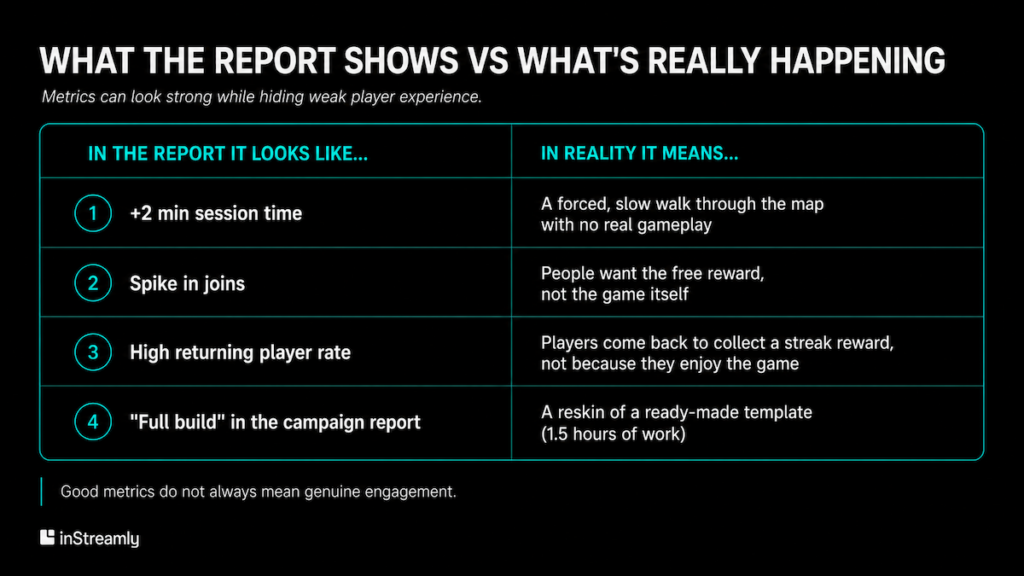
Four ways branded games inflate their own metrics:
- Gameplay time inflation. A player is sent running across the map at a deliberately slow pace with no gameplay happening during that run. Two minutes pass. Nothing about those two minutes builds a memory of the brand, but the session-time report now shows two extra minutes of “engagement.” The same pattern shows up in platforming sections with no checkpoints, where falling once sends a player back to the very start, and in collection quests that ask for thirty of an item when five would have made the same point. The problem is when the difficulty or length exists purely to stretch a five-minute experience into a twenty-minute one for the sake of the number, not the player.
- Engagement farmed through giveaways. Handing out a free item or a discount code for joining a game will always produce a join spike, but a join spike caused by a giveaway is not evidence that the game itself is good. It measures how much people like free things, which was never in question.
- Daily login streaks. Players return to collect an asset rather than because the gameplay pulled them back. This is a standard mechanic in commercial games and not inherently predatory, but it is also not evidence of quality, and it is a mechanic parents specifically dislike because it rewards habit over interest.
- Reskinned production shortcuts. Roblox offers preset game templates, and some branded experiences are built by reskinning a preset with new assets and nothing else. A build that took an hour and a half of actual development can still be sold internally as a major campaign, because nobody on the brand side compared the finished game against the template it came from.
Does the growing 17 to 24 audience change the calculation?
Roblox has been promoting the growth of its older user segment, and it is real: the 17 to 24 group made up around 21% of users in early 2025. But this does not change what a branded game is actually reaching, for two reasons:
- Age on Roblox is self-reported inside most experiences, so a brief that assumes it is talking to an 18-plus audience because that is who the game is nominally aimed at has no way to confirm that.
- Roblox introduced ID verification earlier in 2026, but branded experiences rarely use it to actually restrict access to adult-only content.
Until a branded game uses that verification to gate itself, the audience a brand is designing for and the audience it is actually reaching are two different groups, and the younger one is still the larger one.
What actually separates a good branded Roblox experience from a PR screenshot
Two tests catch most bad Roblox briefs before they go into production:
- The spend-and-compare test. Does the mechanic require the player to spend money, feel urgency, or compare themselves to other players? If yes, it should be redesigned or cut. This is the same discipline that keeps branded integrations from getting rejected by gaming communities more broadly: players notice when a mechanic serves the brand’s metrics instead of their own experience.
- The measurement test. Would this mechanic still exist if nobody was going to measure session time? If the honest answer is no, it is inflation, not gameplay.
The PKO Bank Polski Fortnite branch is a useful reference point here, not because the mechanics transfer directly, but because of the funding model. The brand paid for the experience so the player didn’t have to, and the 26-minute average session time came from players voluntarily managing their own in-game plots and businesses, not from a slow forced run across a map.
Before approving a Roblox brief, check for:
- No Robux purchases required to access or complete the experience
- No randomized reward mechanics: no loot boxes, egg-hatching, or chance-based reward draws
- No artificial scarcity on branded items; if it exists, it stays available permanently
- No forced traversal, uncheckpointed platforming, or padded collection quests used purely to extend playtime
- No production shortcuts sold as full builds; the game was actually built, not reskinned from a preset
- Cosmetic rewards are given for engagement, not sold for Robux
- The experience has been played start to finish by someone on the brand side, not just reviewed in a metrics dashboard
Key takeaways for marketers
- Two separate regulatory tracks. Roblox’s exposure is split between predator safety (the $35.8 million settlement) and manipulative design (the pending FTC complaint). Both are relevant to a branded brief, but they are not the same risk.
- Predatory mechanics are inherited by default. Loot boxes, obscured Robux pricing, and manufactured scarcity are risks a brand takes on unless the brief explicitly designs against them.
- Metrics inflation is the more common failure. Slow traversal, padded fetch quests, or a reskinned template can hit every KPI without producing a player who remembers the brand.
- The 17-to-24 audience doesn’t change who you’re reaching. Age remains largely self-reported, and ID verification isn’t being used to restrict branded content.
- The only audit that works is playing the game yourself before it ships, not reading the report afterward.